
Amy Abdelnoor on her debut novel Ever Land: ‘I felt like I was method acting my book’
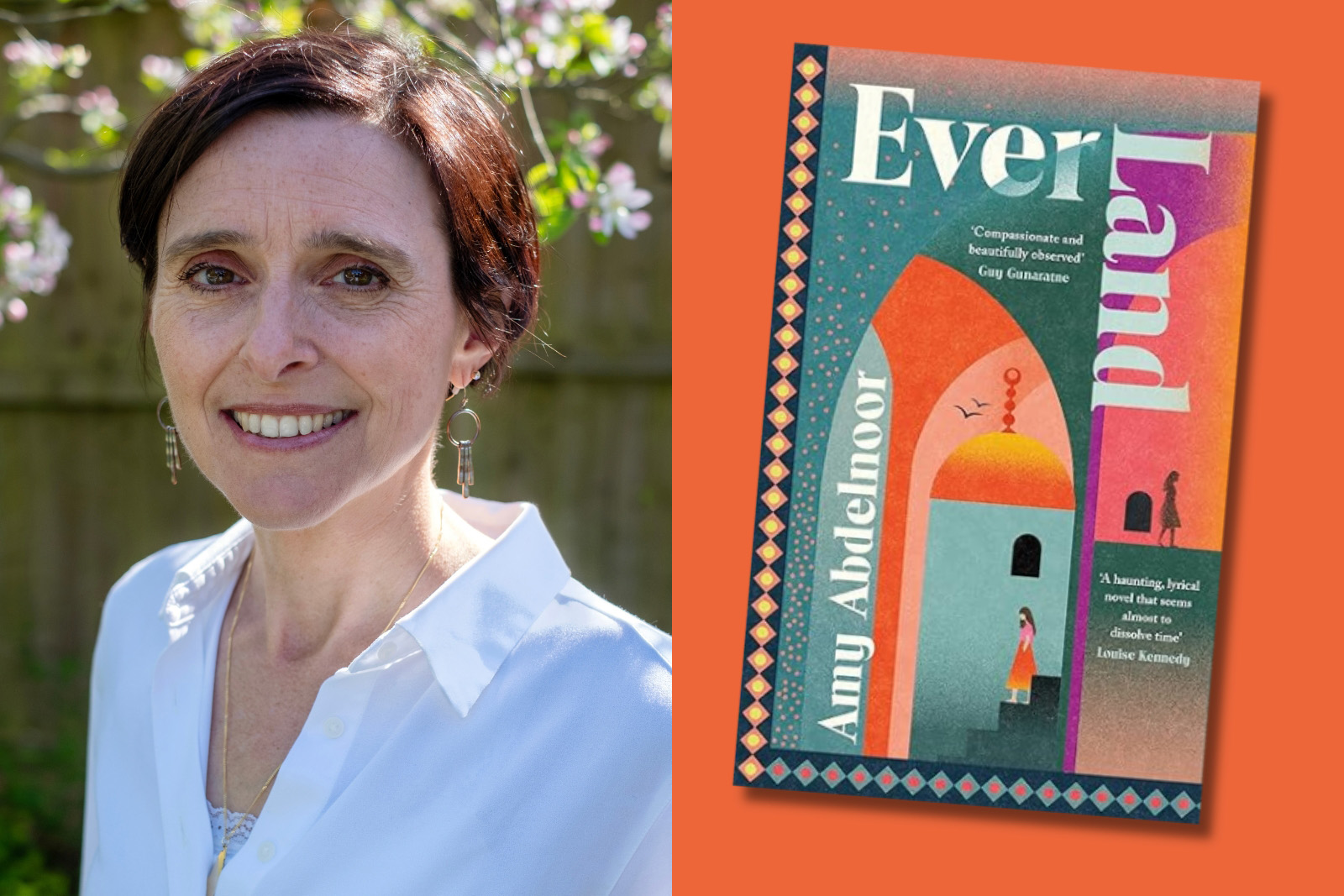
The British-Arab author speaks about the inspiration behind her book, Palestinian displacement, shared humanity and the cost of Israel’s occupation

Amy Abdelnoor waited decades to write Ever Land, her debut novel, about displacement, shared humanity and the cost of Israel’s occupation.
It follows Dinah, a British-Jewish teenager who moves from north London to an Israeli settlement in the West Bank, and who is watched over by the spirit of Safa, a Palestinian girl killed during the six-day war, fought in 1967 between Israel and a coalition of Arab states.
Unable to move on, Safa’s spirit is trapped, searching for the little sister she was separated from the day she died. It is a courageous debut that forces the reader to connect the dots between the Palestinian people’s past and present.
When the 48-year-old British-Arab writer, who works as a secondary school English teacher, finally put pen to paper in 2019, she didn’t know that five years later she would be editing her manuscript during Israel’s war on Gaza, now on hold with a fragile ceasefire.
Those nights, Abdelnoor would lie in bed watching on her phone the horrors endured by Palestinians in Gaza. “I felt like I was method acting my book. I felt like I was Dinah, living a normal life, being visited by everything Palestinian,” she says.
“I had the cognitive dissonance that I think lots of us have, of opening the fridge to feed the children and thinking about starving children, or worrying about a leaky roof and then thinking, ‘It’s just a leak, we’re not in a tent.’”
Abdelnoor still feels the weight of this dissonance since the book was published in July — an achievement that she describes as “an actualisation of something that has been in my heart forever”.
The novelist Elif Shafak recently chose Ever Land as one of her recommended books to read this summer, and it has been praised by Rose Tremain and Colum McCann. Yet whatever personal fulfilment she feels about the book, Abdelnoor is careful to say that it remains “subordinate and separate” to her feelings about the genocide and occupation Palestinians are living through.
Ever Land moves between the two girls’ narratives but is set in Dinah’s timeline. In 2000, Dinah moves to a gated community with her family. Grieving her father’s death and navigating tense new dynamics with the stepfather who uprooted them all, she tries to settle into a life that feels alien. She can’t put her finger on it, but everything feels off — like something about her new life is terribly wrong, including her new relationship.
Abdelnoor intentionally wrote Safa in the present tense and Dinah in the past. “While Safa is an embodiment of the past, she is ever present,” she explains. The author was inspired by the theoretical physicist Carlo Rovelli’s idea that time, instead of passing, coexists. Like in music, she says, “you’re only ever hearing one millisecond of a song” while holding the notes before and after in your head.
“That’s what’s going on in the book. The past is continually present for Palestinians.”
Abdelnoor describes writing the book as assembling a jigsaw puzzle with pieces she had gathered for years, without seeing the whole picture. One piece was a Guardian article about an American couple whose inherited house in Dallas was bulldozed by mistake, the demolition order sent to the wrong address.
“I just remember thinking, I know somewhere where this happens the whole time, where houses are destroyed,” she says.
Another was rereading writer and poet Mourid Barghouti’s memoir I Saw Ramallah, with its argument that the order in which a story is told changes who seems to be at fault — if you begin at the retaliation rather than the original injustice, the wronged look like the aggressors. Then one day the pieces coalesced into a single image.
“I had a vision of this girl, newly arrived in a gated community, feeling really out of place, ironically unsettled,” she says, “and she’s being watched by this spirit soul. That’s where the book starts.”
Abdelnoor’s connection to Palestine reaches back to her student years. She studied English and then Arabic, in order to reconnect with her Lebanese heritage, at Cambridge University in the late 1990s. It was a Palestinian teacher who told her about a charity that worked in refugee camps in Lebanon, and so, at 19, Abdelnoor moved there to volunteer.
One of the first friends she made while volunteering in the West Bank was a woman 10 years older than her, whose family had been displaced in 1948 from a village in the north of historic Palestine. During the 1982 Israeli invasion of Lebanon, aged 14, the woman had seen Israeli soldiers shoot and kill her parents as the family fled by car. She was then left to raise her younger siblings. “Her story stayed with me,” Abdelnoor says, “alongside, of course, many, many other stories in the camps.”
This woman later asked Abdelnoor to find the village her family had been driven out of.
“Lots of these villages have been built over by car parks or so-called national parks,” she says. “But her village hadn’t been. And when I got there, you could tell it was the village, because there were some old stones from the houses, but also because the sabir plant was growing.”
The sabir — a prickly pear cactus symbolic of Palestinian resilience — became the novel’s guiding image and was also the book’s original title. “They can destroy the people, and they can destroy the buildings, but you cannot destroy the land and what it holds,” Abdelnoor says. “The land will speak.”
Related content
Abdelnoor spent 18 months living in Ramallah and during this time tried to relay what she was witnessing to friends in Britain. “I would email home to anybody whose addresses I had, writing about what I’d seen that day.”
Then, one day, she got a reply from a university friend that shocked her.
“‘There are two sides to every story, Amy, and you’re getting very entrenched in one of them’,” it read.
“If I could bring you here for a week, for a day, even for an hour, you’d get it,” Abdelnoor replied.
“In a way,” she says, “the whole book is a response to that friend.”
In August of 2023, Abdelnoor went to Tel Aviv to walk the streets Dinah would have walked on, a city she’d never set foot in during her years in Palestine. Moving on through West Jerusalem and into the West Bank, she was struck by how far Israeli society had hardened since she’d last lived there nearly 25 years ago and how much further Palestinians had been hemmed in. “I felt that, very profoundly different from when I had been there last,” she says.
“Safa is everything that I feel for Palestine,” Abdelnoor reflects. “I think she is the embodiment of the pain, the injustice, the anger, the love, everything I’ve felt, experienced, an amalgamation of all the people I’ve met, but also of what Palestine means to me.”
Ever Land is available as a hardback (£16.99), ebook and audio download from Hutchinson Heinemann.