
Knife brings the real human tragedy of Salman Rushdie’s stabbing into the light
Director Alex Gibney’s documentary offers an intimate, nuanced and moving view of the author’s life after the shocking 2022 attack

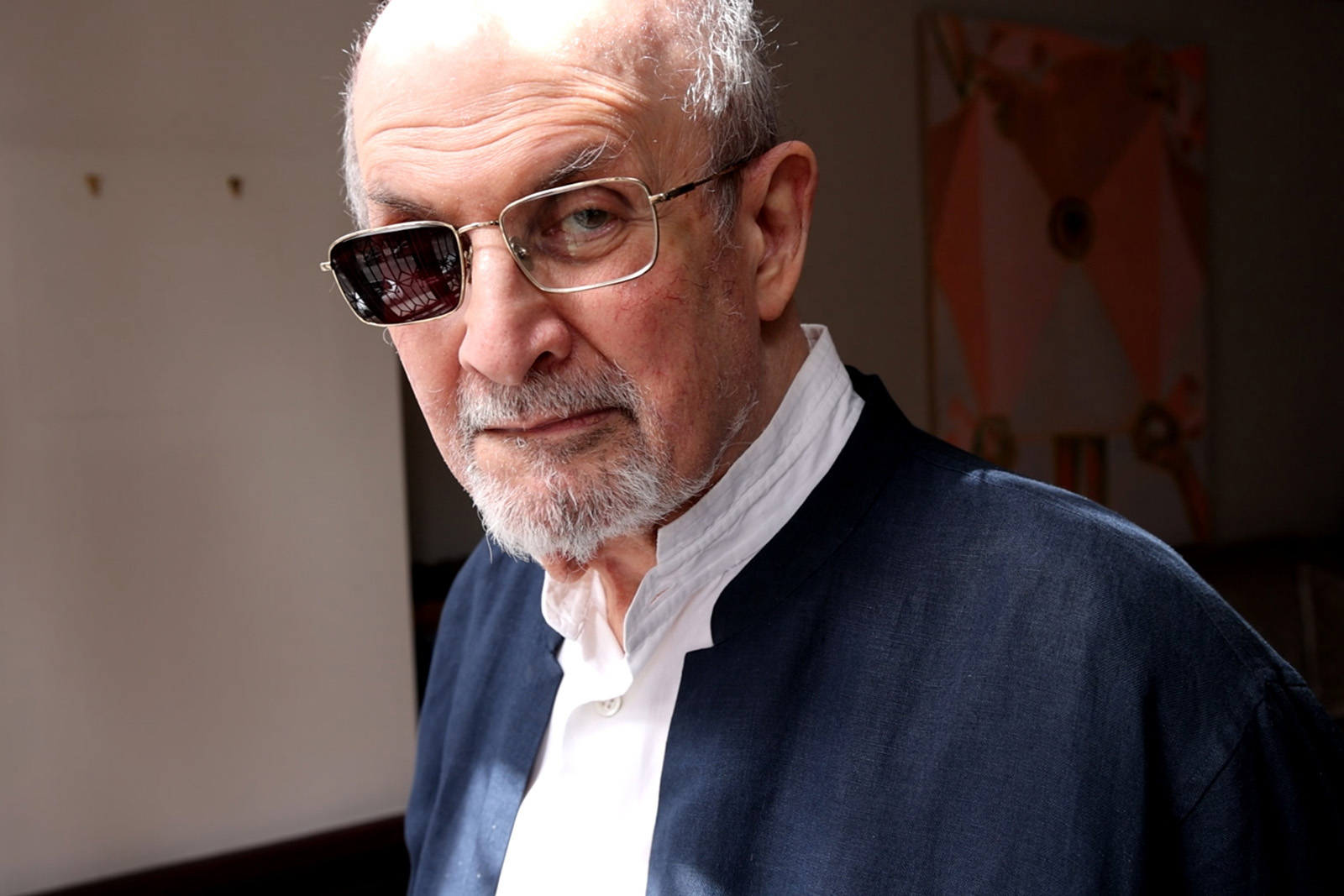
There is something truly shocking in how much of the author’s damaged body we see in Knife: The Attempted Murder of Salman Rushdie. His right eye is ripped apart. Staples run down his neck. His left hand, shredded in a brutal attack carried out by a lone assailant, no longer seems wholly part of him. Rushdie’s wife, the writer and photographer Rachel Eliza Griffiths, films the slow and often humiliating work of putting a life back together after somebody has tried to end it.
For more than three decades before a blade plunged into Rushdie’s body, the possibility of his killing had loomed large. The fatwa issued by the Shia cleric and supreme leader of Iran, Ayatollah Ruhollah Khomeini, in 1989 made his death an international political and religious question. Rushdie became a symbol of free expression and those who wanted him dead became the ultimate symbols of religious intolerance. Somewhere in the decades of argument that followed, both Rushdie and Islam came to be viewed as considerably less complicated than either really were.
Alex Gibney’s film, based on Rushdie’s memoir Knife: Meditations After an Attempted Murder, begins with the horrible corrective of flesh. On 12 August 2022, Rushdie was about to give a talk at the Chautauqua Institution in upstate New York when Hadi Matar ran onto the stage and stabbed him 15 times. Rushdie survived, but lost the sight in his right eye and suffered other serious injuries including to his neck, chest and left hand.
Gibney is not a filmmaker who normally deals in intimacy. The director of Enron: The Smartest Guys in the Room, the Oscar-winning Taxi to the Dark Side and the Scientology exposé Going Clear has spent much of his career worrying away at stories that have hardened into accepted narratives. His documentaries are investigative without pretending that assembling facts is the same thing as finding truth. Archival material, interviews and reconstructions jostle together until something familiar seems radically unjust.
His eye for injustice and broader context suits the story of Knife particularly well. Rushdie and his wife had considered making something themselves from the footage Griffiths shot during his recovery, but decided that they were too close to it. Gibney builds outwards from those extraordinary home videos, incorporating Rushdie’s narration, archive footage and animation. The attack itself is initially reconstructed from Rushdie’s fragmented perspective, the horrifying footage captured at Chautauqua withheld until later. When we eventually see this, it embodies in the most shocking of ways decades of people wishing Rushdie dead.
Griffiths began filming her husband in hospital and continued through his rehabilitation. Rushdie attempts exercises with his damaged hand and navigates the altered vision caused by losing an eye. Griffiths turns the camera on herself too, exhausted and frightened as she cares for someone whose survival has not made the horror disappear.
Gibney also returns to the book that started everything. The Satanic Verses, published in 1988, is a sprawling magical realist novel about two Indian actors who miraculously survive the explosion of a hijacked plane. Within one character’s dreams Rushdie reimagines episodes from early Islamic history. A prophet resembling Muhammad is called Mahound, a medieval Christian slur, prostitutes adopt the names of the Prophet’s wives and the novel plays with the disputed story that Muhammad briefly accepted verses inspired by Satan as divine revelation. For many Muslims, these passages were not playful theological inquiry but a grotesque insult to the sacred foundations of their faith.
Protests followed around the world, then Khomeini issued the fatwa calling for Rushdie’s death. Rushdie disappeared into police protection. His book was burned and people associated with it were attacked. Most horrifically, its Japanese translator, Hitoshi Igarashi, was murdered by an unknown attacker in 1991. In 1998, the Iranian government publicly distanced itself from the death sentence, although the fatwa itself was never formally revoked.
For British Muslims, this history has always been difficult territory. The Rushdie affair became one of the defining stories through which Islam in Britain was understood, with an entire diverse community too often represented by the most extreme responses to a single book. Images of copies burning and protesters calling for Rushdie’s death became shorthand for Muslim intolerance, leaving ordinary Muslims to answer for views they did not necessarily hold. Rushdie himself became difficult to separate from that argument: a man whose persecution was repeatedly used to make sweeping claims about the faith of millions.
That history makes the 2022 attack particularly painful to reckon with. After decades spent resisting the idea that Islam is inherently violent or intolerant, here was a Muslim man attempting to murder Rushdie. It seemed to confirm the very caricature Muslims had been fighting against and fear of feeding that caricature does not make Rushdie’s suffering any less real.
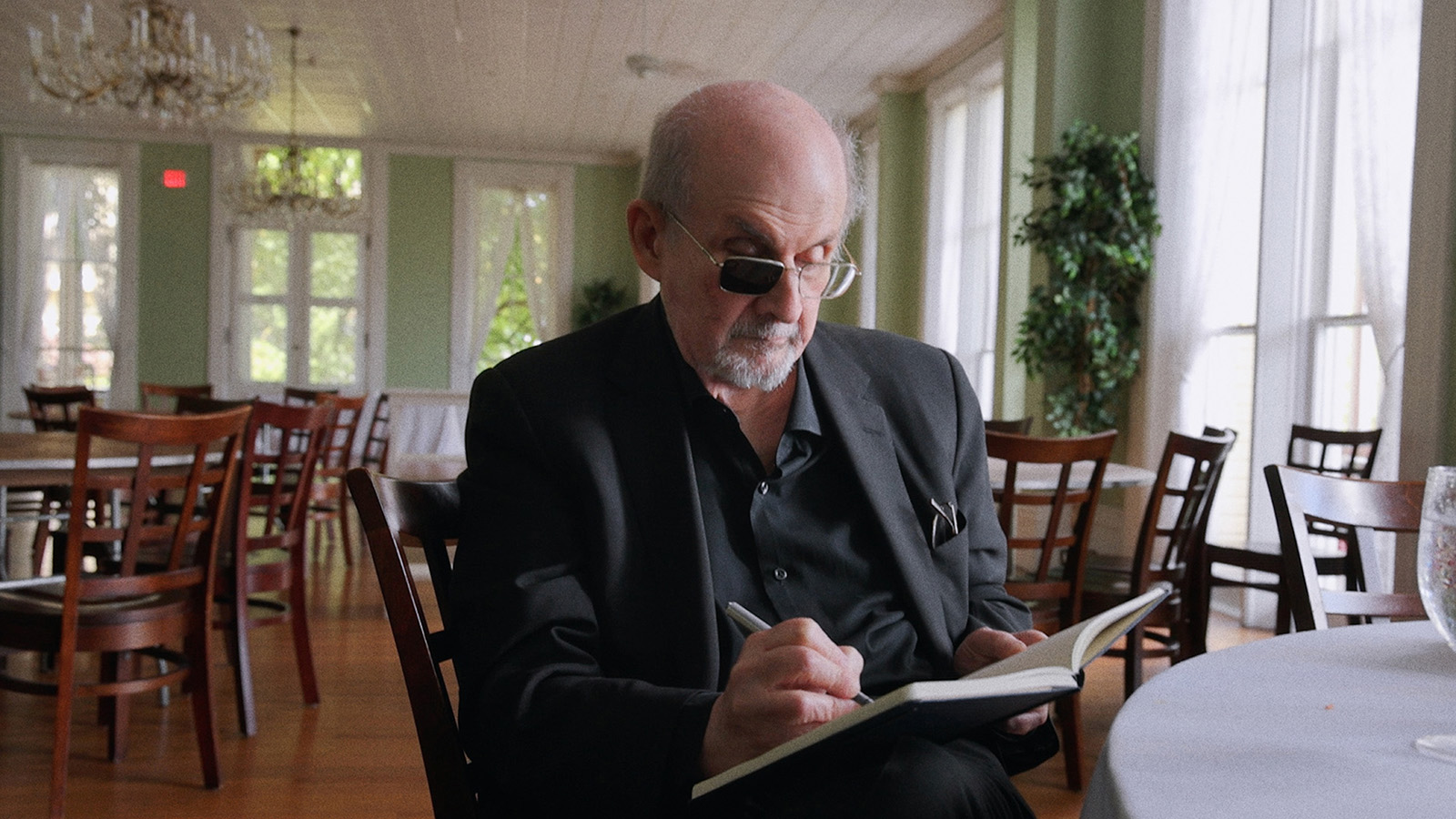
What is so valuable about Knife is that it refuses the safety of symbolism. Rushdie ceases to be merely the secular saint of free speech and becomes Salman again: frightened and funny, often vain, frequently furious. Against the mundane indignities of physical recovery, decades of grand abstraction suddenly look absurd. Chillingly, Matar was not even born when The Satanic Verses was published. Decades later, he spent more than a year researching the fatwa and its continuing validity before attempting to carry out its demands.
There is something grimly contemporary about an old grievance finding a young man through the internet. The technology was new, the animus had been waiting for a new pair of hands.
Then Knife travels in the opposite direction, away from the grand argument and towards ordinary life. Rushdie exercises his damaged hand. Griffiths helps care for him. They joke and bicker. Recovery takes the less photogenic form of marriage: fear, irritation, tenderness and the repetition of small tasks until life begins to resemble itself again.
There is a moment in almost every culture war when the people involved become less important than what they are made to represent. Rushdie became the persecuted writer, while the people who wanted him dead were made representative of an entire faith. For decades, the argument grew larger as the people inside it became smaller.
Knife cannot resolve the arguments surrounding Rushdie, nor should it. Instead it gives us the broken remnants of an author’s hand struggling through another exercise, Griffiths holding a camera as her husband recovers, and Rushdie returning to the place where somebody tried to kill him. His attempted murder was a tragedy, not useful evidence for anybody’s argument. This film finally gives back to Salman Rushdie, the human being, his place at the centre of it.