‘Self-defence is no offence’: a story of anti-racist action on the streets of east London
In his new book, Come What May, We’re Here to Stay, Taj Ali chronicles the long history of political activism by the UK South Asian community. Here, we present an exclusive extract

The following edited extract contains descriptions of racist violence and offensive language.
Altab Ali Park is the only public space in east London to bear the name of a Bengali person. It’s a small green square on the former site of a 13th-century church, the chalk walls of which gave the wider area its name of Whitechapel.
This rare and poignant tribute is a product of tragic circumstances. On 4 May 1978, Altab Ali, a 24-year-old textile worker, was headed home from work along Adler Street when three teenagers cornered him and stabbed him, later confessing at trial that they had targeted Ali because he was “a Paki”.
It wasn’t the first racist killing in east London, nor would it be the last. Two weeks before, 10-year-old Kennith Singh was stabbed to death by racists in Plaistow. He suffered eight knife wounds to the back of his head. Two months later, in June 1978, Ishaque Ali died of heart failure after a vicious racist attack in Hackney.
What made Altab Ali’s killing particularly explosive was its context: he was fatally stabbed on the night of local elections. That year, the National Front (NF) put up candidates in every ward in Whitechapel. In the years leading up to the poll, NF-influenced gangs had terrorised South Asian communities in the area.
Rajon Uddin Jalal was a Bengali teenager living in the area at the time. “There were racist attacks every day,” he recalled. “We knew the streets weren’t safe for us. But the murder of Altab Ali was shocking.”
Following Ali’s death, a number of local youth groups were set up to combat the threat posed by the NF and other racist organisations. One of the most prominent was the Bangladesh Youth Movement (BYM), which Jalal played a central role in establishing.
“Groups of us from the Brick Lane area and other neighbourhoods, like Commercial Road, where the Bangladesh Youth Movement was based, we all got in touch and immediately organised an informal meeting,” he said.
Related content
“It came about spontaneously. We met in the East London Mosque. We demanded that the premises of the Bangladesh Welfare Association behind the mosque be opened up as a space for us to discuss what actions we should take… The community was getting mobilised.”
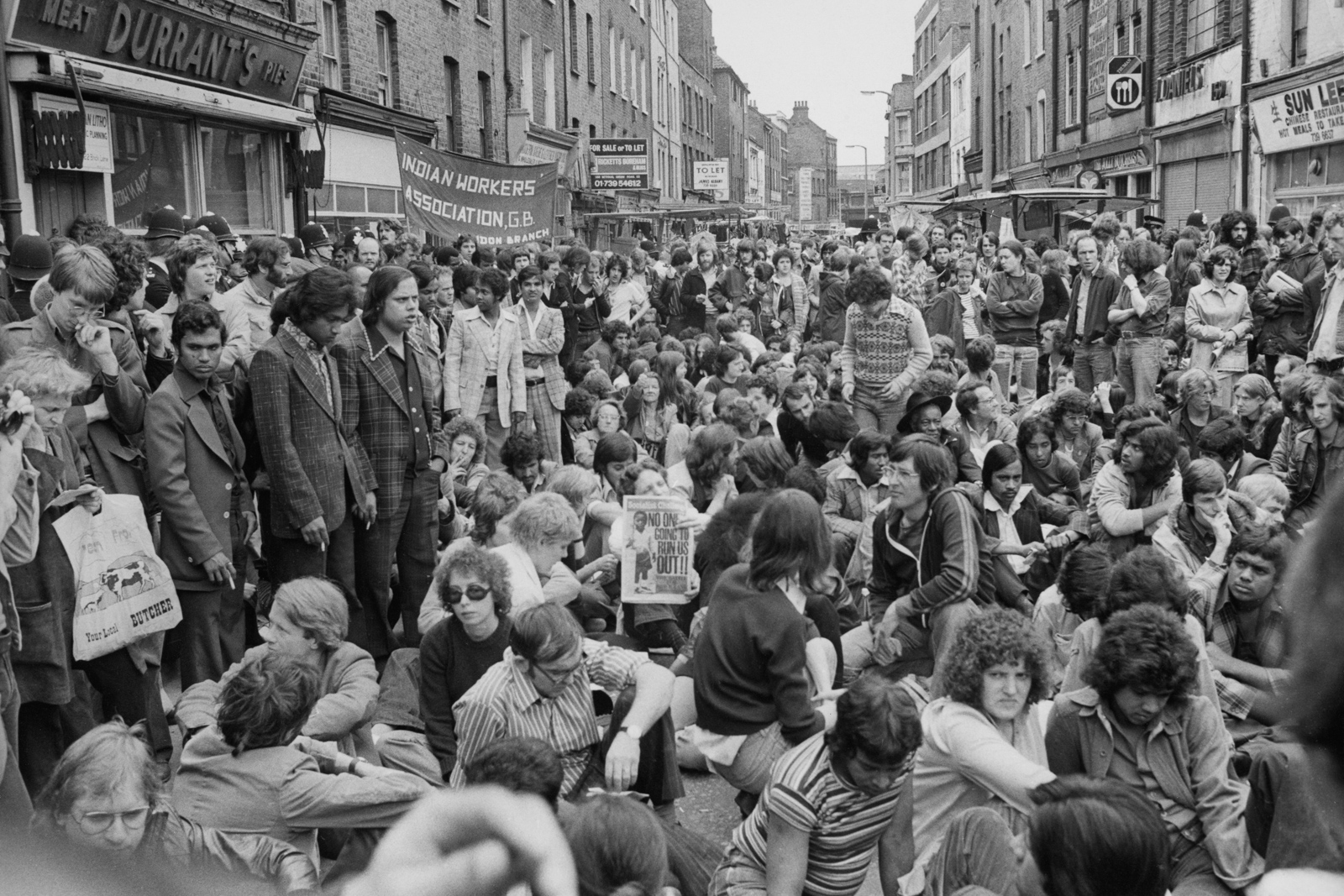
On 14 May, 10 days after Ali’s killing, 7,000 people marched behind his coffin, from Brick Lane to Hyde Park and then on to Downing Street. They called on the government to take meaningful action against racist violence. The protesters held placards that read “Here to stay, here to fight”, and “Self-defence is no offence”.
“The protest was led by Bengalis but about a quarter were white demonstrators, mainly from the Anti-Nazi League (ANL),” said Jalal. “It was the Anti-Nazi League who delivered for our demonstrations. They mobilised a lot of people.”
In addition to the BYM, youth-led community action groups included the Bangladesh Youth Front, the Progressive Youth Organisation, the Bangladeshi Youth Association and the Bangladesh Youth League. Many focused on community defence, but also provided sports, cultural and social activities. It was through these organisations that a generation of assertive anti-racist activists emerged.
On Sunday, 18 June, the BYM worked with the ANL to organise a protest against racist violence and intimidation. A pattern emerged throughout the summer, with further attacks on the South Asian community sparking more demonstrations.
“There was something happening every day,” recalled Jalal. “There would be rallies and demonstrations outside police stations. There were sit-down protests in Bethnal Green.”
Another tactic was trialled by local activists on 17 July 1978. The newly formed Hackney and Tower Hamlets Defence Committee organised a Black Solidarity Day, which saw 70% of South Asian shops in the East End close in protest against the escalating violence. Eight thousand restaurant and factory workers around Brick Lane also went on strike for the day.
“We closed down the area. It was the first ever Black strike against racial attacks. And people from different walks of life came to join us. Workers from the Ford Motor Company came to join us,” Jalal recalled, referring to the approximate 1,000 employees from the company’s Dagenham assembly plant who, alongside students from several local schools, came out in solidarity.
“It was an important day because it sent out a signal. We were going to fight for our equal rights as equal citizens of the country, and for dignity and self-respect,” said Jalal. “We had had enough of scapegoating and Paki bashing: it was time for the whole community to fight back.”
That evening around 2,000 people marched through the East End. When racists in a car provoked members of the crowd, police arrested three demonstrators. Protesters held a sit-in outside Bethnal Green police station for more than an hour, until they were released. Throughout the summer, weekly clashes with the NF took place.
Many of those who played pivotal roles in east London’s fight against racism were not members of organised anti-racist groups, though. Those informal networks of local residents receive little recognition in existing historical literature.
Halima Begum’s family, for instance, were on the frontline. Living off Brick Lane, they experienced NF members and other racist thugs rampaging down their streets, smashing up homes and restaurants.
“Whenever there was a racist group of people running down Brick Lane, you’d need to mobilise,” she recalled. “Because we physically lived there, we’d be first out on the street. It was happening on our front door.
“My brothers Kamal and Iqbal were always out organising the physical protection of our neighbours because the police wouldn’t defend us. They didn’t organise themselves as an entity. It was more about spontaneous organising, the coming together of a community to protect homes and buildings.”
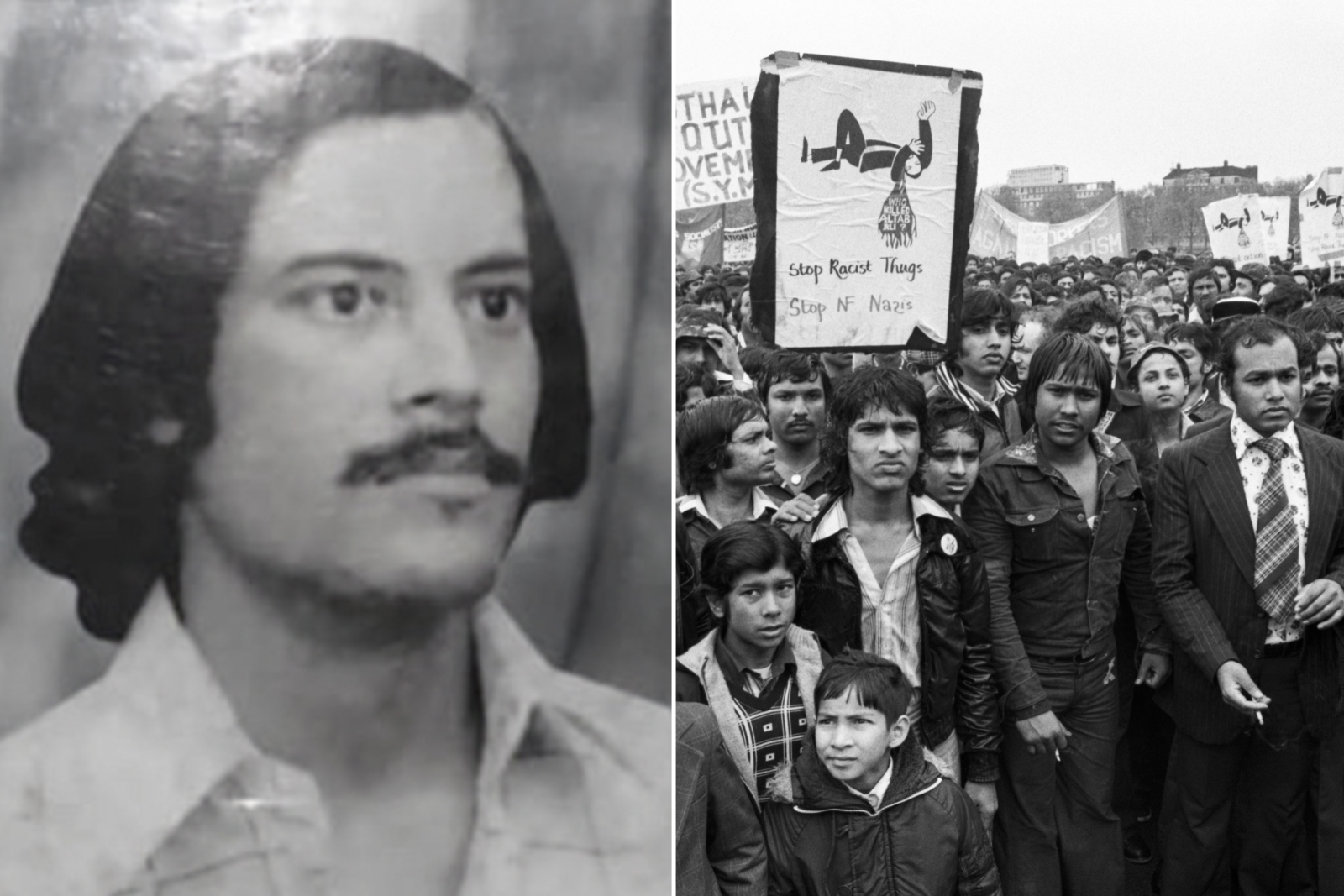
Three teenagers were arrested for the killing of Altab Ali. In November 1978, they were convicted of manslaughter, not murder, as the court believed the attack lacked premeditation. The unnamed 16-year-old who delivered the fatal stab wound was sentenced to seven years in prison, while Roy Arnold and Carl Ludlow, both 17, were sentenced to three years each for aiding and abetting.
When asked by police officers why they had targeted Ali, the 16-year-old replied, “no reason at all” and admitted to attacking local South Asians “on at least five occasions”.
“If we saw a Paki we used to have a go at them,” he said. “We would ask for money and beat them up.”
On Brick Lane, though, the battle lines had been drawn. And in neighbouring Newham, young people would soon have to put up a similar fight.
It was a sunny afternoon on 17 July, 1980, when Paul Mullery plunged a blade into the heart of Akhtar Ali Baig.
Baig had come out of East Ham station and was walking down the High Street when he was savagely attacked by a gang of skinheads — two boys, two girls, all aged between 15 and 17. They stopped him, verbally abused him and spat in his face before Mullery stabbed him to death.
Baig, a 29-year-old Pakistani student at Queen Mary College, had a promising career ahead of him as a chartered accountant. A devout Muslim, he regularly attended the local mosque and was described in the local press as a “respectful, gentle and studious man” by those who knew him. A new life as a father was just weeks away. His pregnant wife Nasreen was in Pakistan and hoped to join him in England. But their dreams of a family were cut short by a senseless racist murder.
The skinheads, who had been drinking at the Duke of Edinburgh pub that afternoon, had put a £5 bet on who could kill the first “Paki”.
As shoppers stopped in their tracks, a 24-year-old passerby named Mick Byrne saw Baig collapse against a wall and attempted to save his life.
“I saw the blood on his jeans and blood coming from his chest… every now and then he was gasping for breath,” Byrne recalled. “He was trying to say something. I tried to calm him down, telling him, ‘You’ll be alright,’ but then he just went limp and I covered his head with a blanket.”
Young people from the local Asian and Black communities were furious. Not long after Baig’s murder, More than 100 marched to Forest Gate police station on Romford Road. Outrageously, the police claimed Ali’s killing was not racially motivated, but merely the result of a mugging. Angered by such clear disregard, the crowd marched back to the spot where Baig took his last breath, then clashed with police officers. Sixteen people were arrested.
Newham already had a history of racist violence. Just a few years earlier, in 1977, Mohinder, Balvinder and Sukhvinder Virk were working on a car outside their family home in East Ham when they were set upon by a group of white men. Verbal abuse quickly turned physical. In the struggle that followed, one of the attackers was stabbed.
The brothers’ relatives phoned the police, expecting protection. Instead, officers promptly arrested the Virks. They were denied bail, treated as criminals rather than victims and, eventually, tried at the Old Bailey.
The court proceedings revealed the prejudices of the time. The prosecution relied on testimony from the very men who had instigated the attack, while the presiding judge, Michael Argyle, refused to consider the possibility that racism had played a role. When defence lawyers attempted to raise the issue, he dismissed it as irrelevant.
The Virk brothers received sentences ranging from two to seven years in prison. Those responsible for the killing of 18-year-old Gurdip Singh Chaggar in Southall in 1976, a case that bore all the hallmarks of racial violence, received only four years for manslaughter.
Hardev Singh Dhesi, a prominent member of the national advocacy group the Indian Workers’ Association (IWA), played an important role in rallying support for the Virks.
“When they opened the door, there was no male member of the family, as all the males were in prison, just young wives and their young children,” he recalled of visiting the Virk family’s home. “In normal circumstances, they wouldn’t have invited strangers into their house, but I was amazed to see they just opened the door and said, ‘Come in.’
“After that, we went to Barking Gurdwara and organised a public meeting. We invited all the organisations to study the case and formed the Steering Committee of Asian Organisations — there were just over 20 organisations who came together initially. Within two weeks we raised £4,000 — a lot of money in those days. We published literature, contacted councillors, the Home Office, and solicitors and asked them to appeal against the sentences.”
The following year, the Appeal Court halved the Virk brothers’ sentences, with the judge declaring them “law-abiding citizens”.
Further racist attacks soon followed, including an assault on 19-year-old Narinder Singh Marway on Green Street. Marway had been racially abused, spat on and hit on the head with an iron bar. When the police arrived, it was Marway who was arrested for wearing a Sikh bangle known as a karaa, which police described as an offensive weapon.
The pattern was glaring: young Asian men who defended themselves from attacks were punished, while those who committed racist violence against them were shielded by the system.
By the time of Baig’s murder, frustrations had reached boiling point. For many, his death confirmed what they already knew — that the police and courts offered little protection. Justice would have to be fought for on the streets.
On 19 July, two days after Baig’s death, 2,500 people marched through Newham in protest. A bulletin by the newly established Newham Youth Movement (NYM) documented the gathering. “The tempo and the feelings of the youth was high,” it read. The mood dampened when, on the way to Forest Gate police station, “about six Asian youths were arrested”, sparking a sit-down protest.
The demonstrators eventually secured their release and the march continued on the planned route. The police, however, tried to divert the crowd towards West Ham Park and force attendees to disperse.
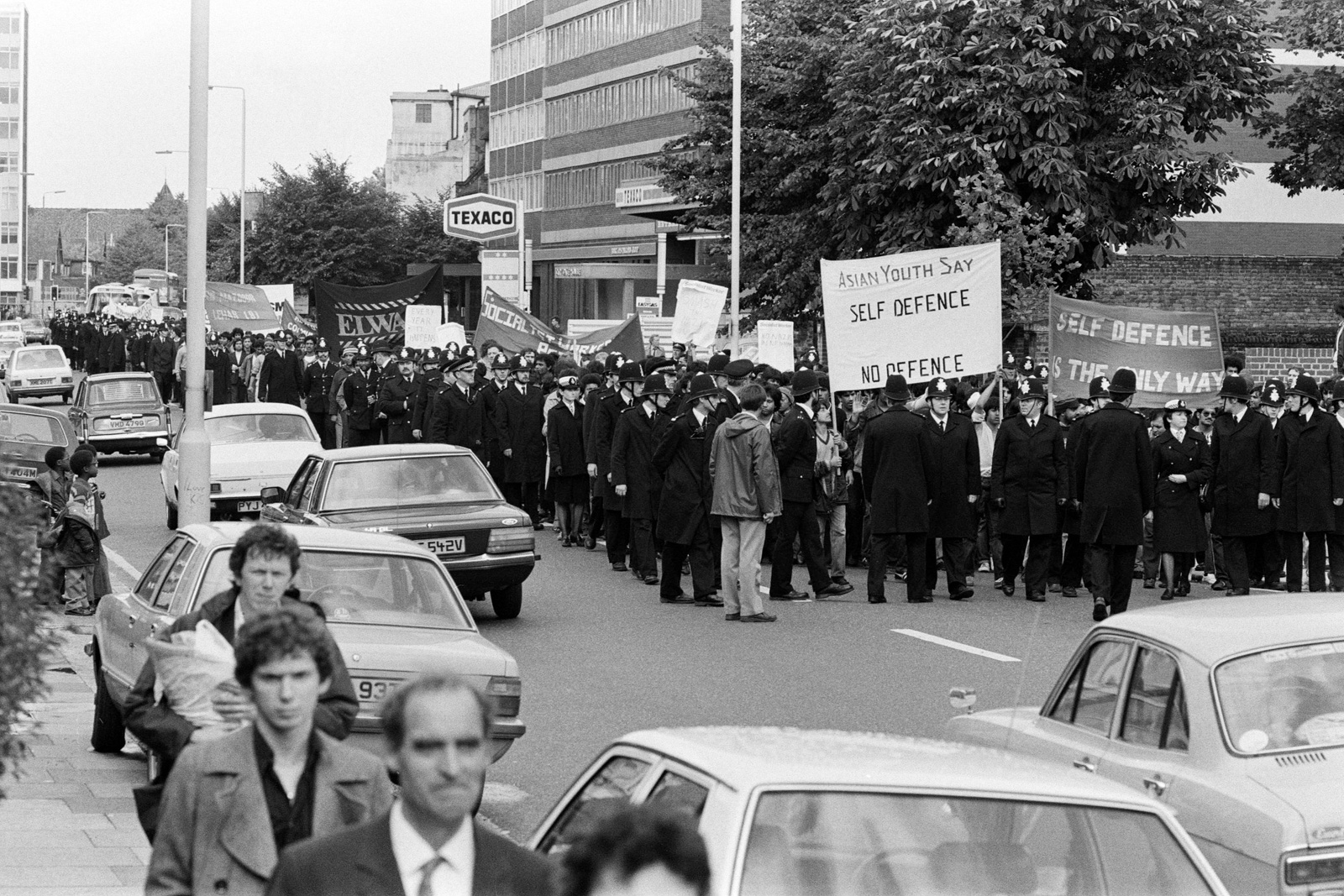
According to the published account, “the youths forced their way through the cordon of police to continue towards their original destination”. In the end, a further 29 people were arrested.
A second march was called after the NYM met with the Steering Committee of Asian Organisations. More than 5,000 people took part, and the whole of East Ham was brought to a standstill. Once again, Black workers from Ford came out and local shopkeepers closed their businesses for the day.
Years later, Unmesh Desai, a former member of the anti-racist Newham Monitoring Project, recalled the scale of the protest: “What was distinctive… was that everyone came out, young and old, men and women, Asian and Afro Caribbean. As friends told me later, it was actually their mothers who got them all up early and said, ‘Come on, we’ve all got to go on the march.’”
It was, he said, “the most angry and militant march that I’d ever been on”.
More protests were organised during the trial of the four people accused of Baig’s murder. Of those in court, two, Debbie Parker and her brother, James, were known racists. After the murder, the police searched Debbie Parker’s bedroom and found material bearing the swastika and the letters NF, as well as a hat with “NF” and “Pakistanis Out” written on it.

When Mullery, Baig’s killer, was led from the court after sentencing, he gave a Nazi salute and shouted “Sieg heil”. At just 17 years old, he was convicted of murder and jailed for life. The court found insufficient evidence to convict the other three accused.
While the Newham Youth Movement quickly petered out, the killing of Akhtar Ali Baig galvanised anti-racist activists in the borough. The Newham Monitoring Project became one of the most well resourced anti-racist groups in the country, funded by a grant from the Greater London Council. Primarily staffed by Black and Asian people, it continued its mission for more than 36 years and was associated with a number of prominent justice campaigns including the 1993 murder of Stephen Lawrence.
Despite winding down in 2016, the legacy of the project and other similar groups remains to this day. Their achievements can be attributed to one simple conclusion reached in the febrile atmosphere of 1970s Britain — that racism cannot be defeated from above and will only ever be overcome by ordinary people who refuse to look away.
Come What May, We’re Here to Stay by Taj Ali, £20 (hardback) is published by Manchester University Press.