
Arriva North London bus drivers strike over ‘brutal’ heat in their cabs
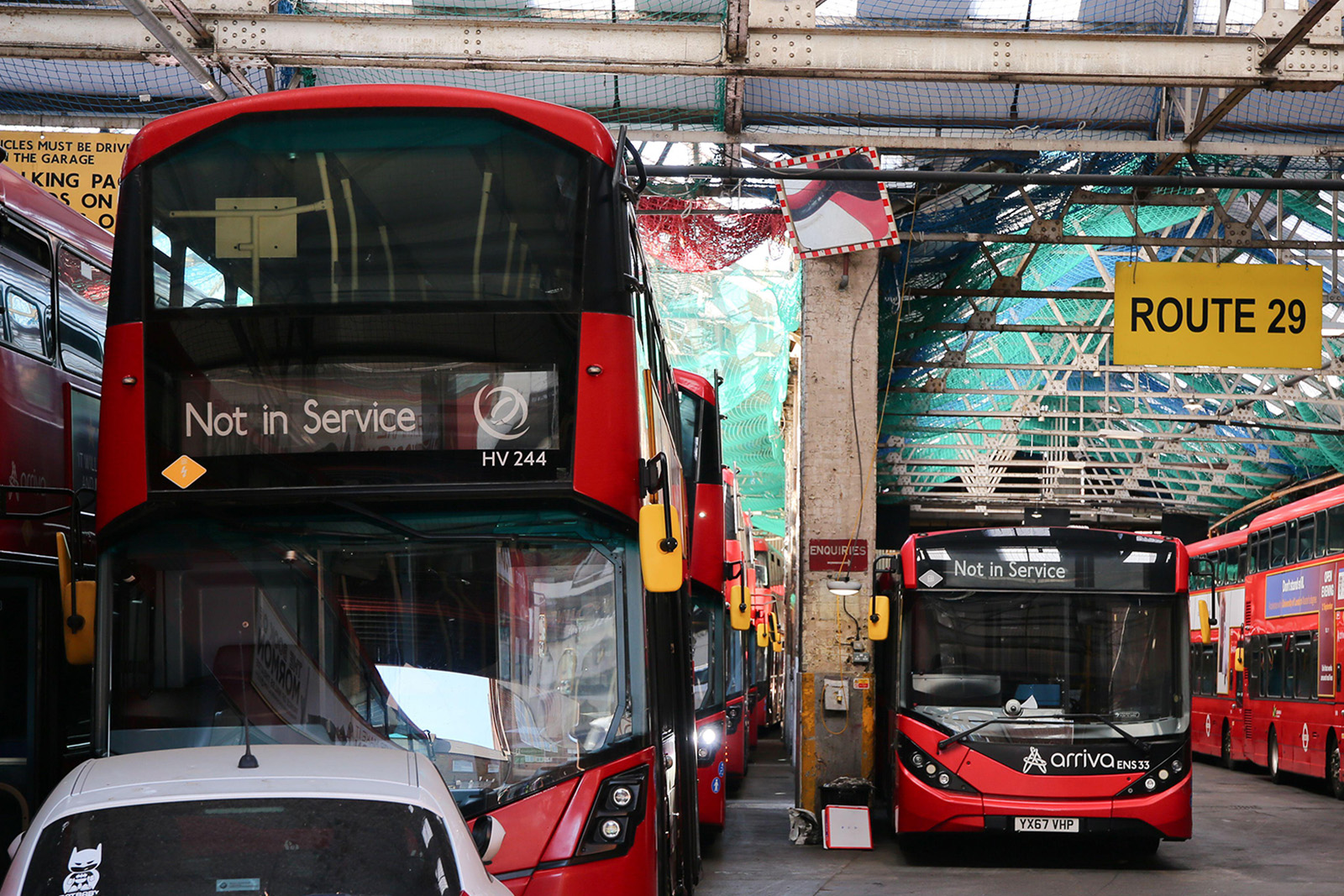
Hundreds of drivers on key London routes are on strike calling for air conditioning as temperatures on board hit 40C

More than 1,500 bus drivers across eight Arriva garages in north London are on strike until Wednesday over what they say are unsafe working conditions amid the extreme heat that has repeatedly scorched the UK this year.
Unite, the bus drivers’ union, said that the north London buses are only equipped with air cooling systems, rather than air conditioning, which reduced the temperature by two to three degrees during the recent heatwaves. Bus drivers who bought their own thermometers have said that temperatures inside drivers’ cabs have reached 40C.
Related content
“A profitable company such as Arriva could easily invest in improving conditions for its drivers and protecting the general public but is instead prioritising greed,” said Unite general secretary Sharon Graham. “We will back our members all the way in this dispute.”
At the Wood Green bus garage on Friday, striking bus drivers came to picket as early as 4am. They were joined by fellow drivers from other garages as well as passengers wanting to show support.
“We’ve been raising concerns about the temperature of the buses for years,” said Ahmed, a driver from a neighbouring garage who came out in support. Like other drivers, he agreed to speak to Hyphen only using a pseudonym. One union rep told Hyphen that Arriva had taken the unusual step of threatening even unionised drivers with disciplinary action for speaking to the media.
The company did not answer questions about whether drivers had been told they would be in breach of their contracts for speaking to journalists, but a spokesperson said: “We ask our colleagues to direct any media enquiries through to our press office. This enables us to provide accurate, timely and consistent responses.”
“When we’re driving and we complain about the heat to the operators through the radio control, they don’t help us. In fact, they punish us,” said Ahmed. “They say: ‘If you don’t drive, we’ll see you in the manager’s office,’ so you feel a lot of fear.”
Ahmed said he had been involved in an accident during the June 2025 heatwave.
“It was my first day back from long-term sick leave and I was learning a new route,” he said. “The air [cooling] was not working — everyone knew that it doesn’t work on that route — so people didn’t even bother reporting. I felt very fatigued. Suddenly I realised my handbrake was not on.” Telling the story, his voice began to shake. “I tapped into the back of a motorbike,” he said. “I managed to put the handbrake on.”
This year, he says, employers have been more vocal in acknowledging the risks of the extreme temperatures.
“We had notices saying we will not be penalised for stopping if our [air cooling] is not working,” he said. “I think if we had those notices last year, before my accident, I think I would have had more confidence to step out when I did not feel comfortable.”
Bus drivers and other transport workers in London are disproportionately likely to be from minority ethnic backgrounds and have found themselves on the front line of a public health crisis before: of the 105 Transport for London workers confirmed to have died from Covid between 2020 and 2022, 33 were Black and 27 were from Asian backgrounds. Most were bus drivers.
Mo Wasim, managing director of Arriva London, said the company took the welfare of bus drivers seriously and understood the impact of the extreme weather.
“We are working closely with Transport for London to support both our colleagues and customers during these hot spells,” he said in a statement emailed to Hyphen. “We’ve introduced short-term measures to protect drivers, and we’re investing in longer-term fixes including cab air conditioning upgrades and our ongoing investment in new fleet.”
But John, a striking bus driver who also wished to remain anonymous, said that the interim measures were of little help. “Every summer, it’s the same,” he said. “And every summer we are told that next year we are going to have the air con. This has been going on for more than four years.
“Last year the summer was brutal. This year it was brutal. This is just going to be the norm now, temperature-wise, I believe.”
He added: “Yesterday, I was on duty at 1.30pm. I had a thermometer on me. The temperature went up to 40 degrees. I try to be prepared. I have a fan and a water spray, but I am getting old now. I’ve hit 70 and I have COPD [a long term lung condition]. When it gets hot, it is hard for me to breathe.” The day in question, 13 August, saw the highest temperature of 2026, according to the Met Office.
Like others, John said that permitting drivers to take a break and step out of the cab when the heat gets too much does not solve the problem when they have to return to the overheating bus.
Related content
“It just takes that one second,” he said. “Sweat drips down into your eye, you close your eyes, and you’ve hit someone. And the first thing they’re going to say? It’s your fault.”
He added that the bus temperatures were also a problem for the passengers.
“After 9am, after all the school kids and workers are gone, my passengers are mostly elderly. I see them in my mirror on a hot day like this and I worry for those poor people,” he said. “Just the other day a lady passed out. We had to call an ambulance.”
John said the situation was redolent of the Covid pandemic. “I’ve had quite a few friends in the business who passed away during Covid, including my best friend,” he said. “When you first join, they give you this spiel about how it’s an easy job. But when it is too hot and you stop because you can’t drive anymore, and the passengers are starting to shout at you, and on the radio the operators start calling you saying you’re taking too long, it’s just not fair. It is not fair any more. We have to take a stand.”
Wasim, from Arriva, said: “We remain ready to sit down with Unite at any time to discuss these important issues and find a resolution that avoids both strike action and the disruption it would cause to customers.”
Routes 19, 29, 34, 41, 66, 67, 76, 102, 103, 121, 141, 149, 150, 158, 175, 191, 192, 217, 221, 243, 248, 254, 259, 279, 307, 313, 329, 341, 349, 370, 375, 377, 616, 675, SL1, SL2, W3, W4, W6, N19, N29, N41 and N279 are affected by strike action.
Future strike dates had been announced until October but Unite suspended them on Tuesday so members could vote on a new offer from Arriva. The union said strike action would resume in a week if the offer was rejected.
Editor’s note: this story was updated on 18 August to reflect the suspension of future strikes while Unite members vote on a new offer from Arriva.