
Adam Azim: ‘When you sign up for a fight, you’re allowing me to punch you in the face’
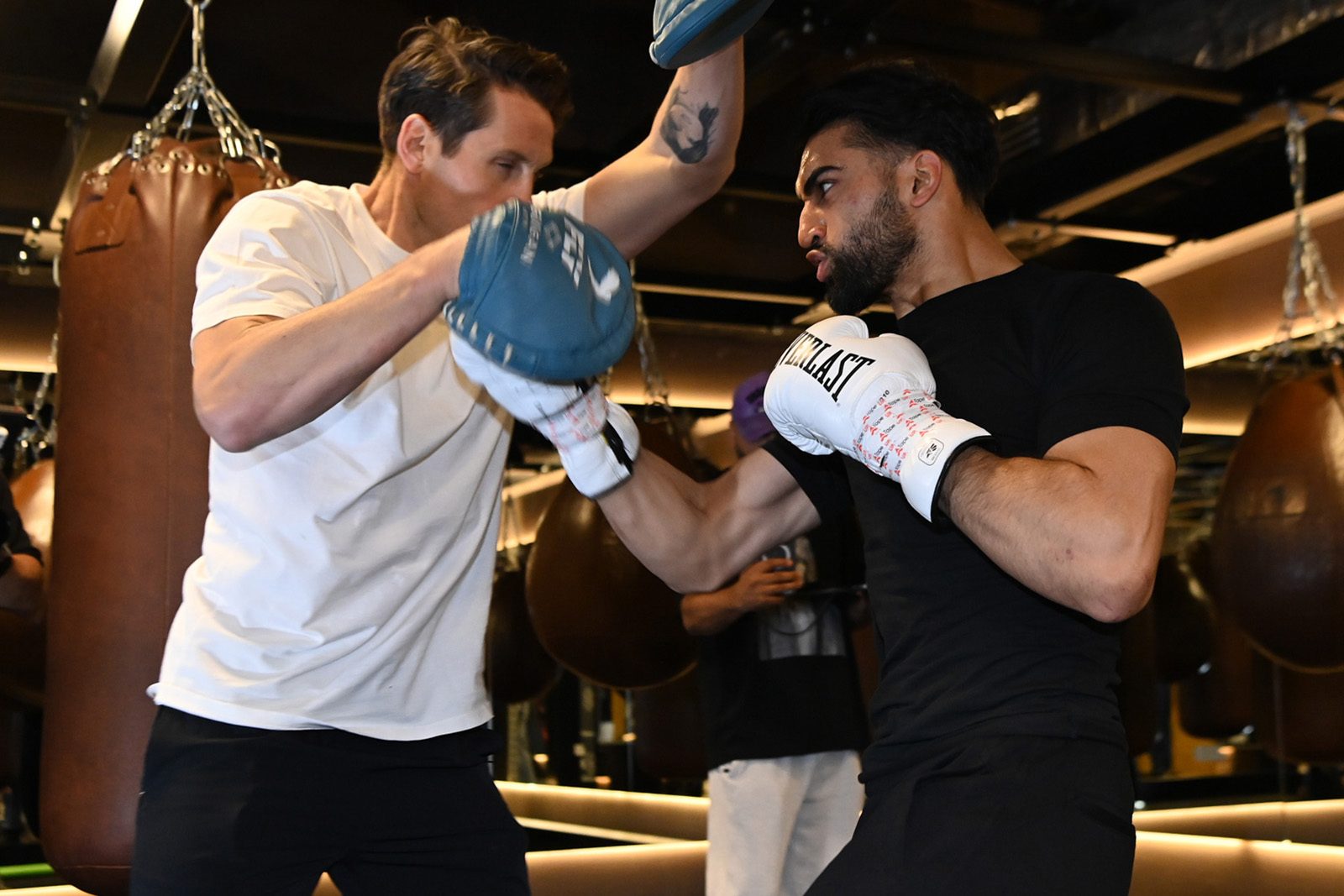
The undefeated boxer is back from injury and moving ever closer to a world title bid

Adam Azim has an impressive record. At 23 years old, the British-Pakistani super-lightweight boxer is undefeated. Of his 14 fights, he has won 11 by knockout. On 30 May, he will take on Steve Claggett, a Canadian boxer 13 years his senior, at the OVO Arena Wembley.
The fight was announced at the end of April, giving him just four weeks’ notice. The bout comes after Azim was scheduled to fight Gustavo Lemos in January, but was forced to pull out by a hand injury. It is a crucial step towards securing a world-title shot in the next 12 months.
Related content
Despite the last-minute announcement, Azim’s demeanour was calm and assured when we met at JAB boxing club in Victoria, London. “I’m feeling really good,” he says. “Body is feeling great, hands are feeling great and I’m looking forward to the fight because I just want to spend some time with the family afterwards.”
Azim, born and raised in Slough, is one of seven siblings. The oldest is his brother Hassan, 25, who is also a boxer, and the youngest is his two-year-old sister.
As a child, Azim admits, he was a handful, which he attributes to his ADHD. “I was a little shit,” he says. “I was really bad. My mum and dad have probably been through hell raising me.”
He recalls flushing a set of keys down the toilet, attempting to stab his dad in the neck with a pen and urinating out of windows. One time a neighbour knocked on the door to alert his parents that Azim was jumping on the roof of the house.
At school, he struggled to concentrate and was suspended multiple times. To keep him occupied, teachers began giving him lumps of Blu-Tack to play with during lessons. He ended up leaving at 14 and was homeschooled until he completed his GCSEs.
“I needed something to drain my energy,” he says. Over the years, his parents signed him up for several sports. In cricket, he batted and bowled. “But I would never field because I was too hyperactive,” he recalls. He also tried his hand at football, at which he was “good but not great”.
The only disciplines that stuck were boxing and kickboxing. Azim put on gloves and began training with his dad in the family garage at the age of four. As there were no organised competitions for children under the age of 11, he took up kickboxing in the meantime. “I just used to punch, so I used to get disqualified for not kicking enough,” he says.
By his 10th birthday, boxing had become his main focus. “With boxing, I could go and punch a bag and control my energy,” he says. “I used to be a lunatic where I couldn’t control it. But once boxing came into my life, I learned to handle it really well.”
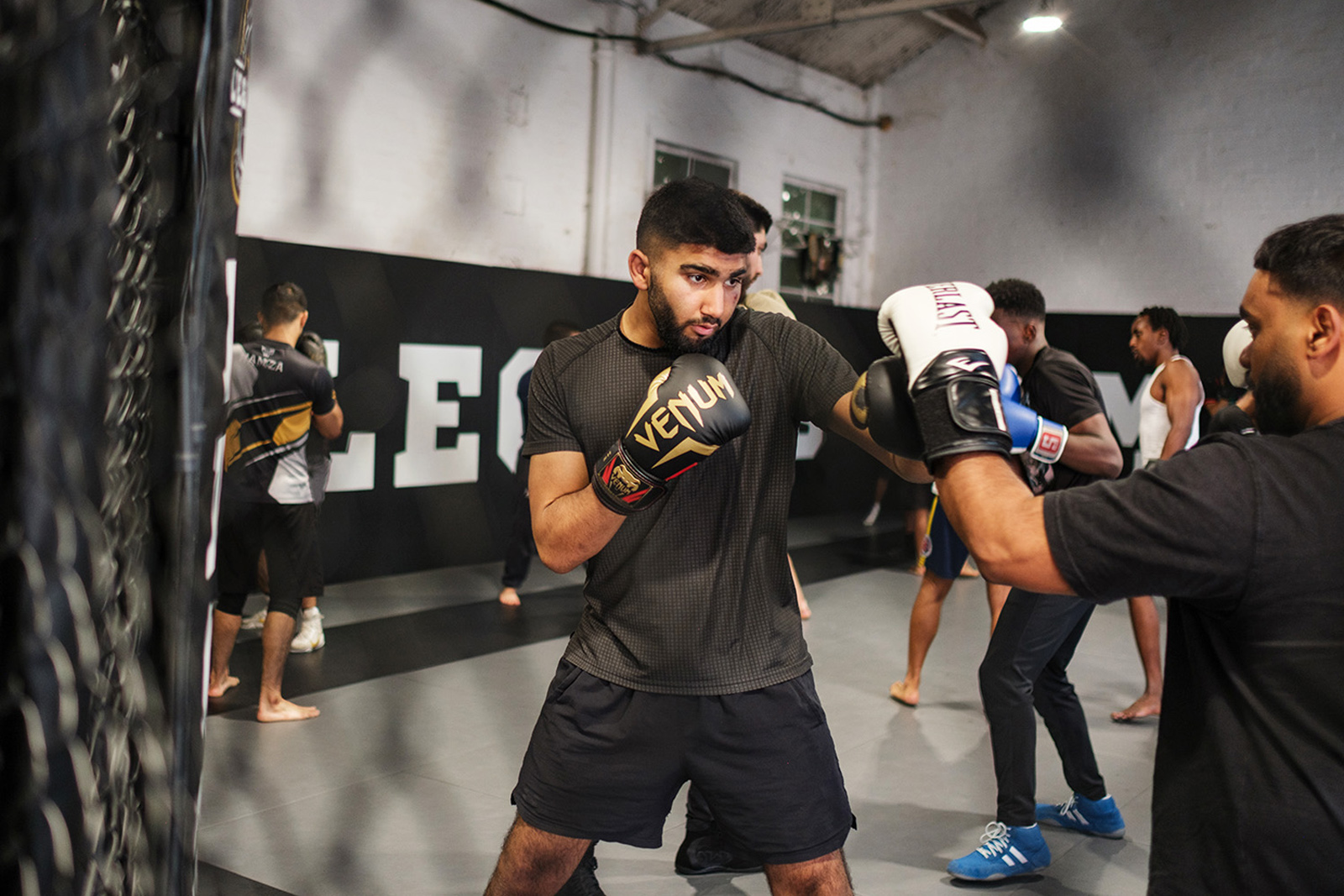
In the run-up to the Claggett fight, Azim is in camp, training three times a day and sticking to a strict diet. Each day starts at around 10am with a warm-up of skipping before a gruelling two-hour training session. “I did 10 rounds of sparring before I came here, then I’ve got sprints, and another session later on,” he tells me.
Azim’s coach, Shane McGuigan, has trained fighters including Luke Campbell, Daniel Dubois, Carl Frampton and David Haye. They met when Azim was invited to spar with Olympic gold medallist Campbell at age 18.
“At the time, Luke was training for his fight against Ryan Garcia,” Azim says. “Shane was there and he saw the potential I had. I always wanted to work with him, so it was great.”
He often ends training days with an ice bath. “I normally fill up the bath with cold water and then chuck around 10 to 15 packs of ice into it,” he explains. “I do that around three times a week. It’s cold and I hate it, but it does have benefits. The longest I’ve done is about 10 minutes. You really have to channel your body to stay in for the first minute but after that you’re fine.”
Away from the gym, Azim is a dedicated student of his sport and its history. For years he has kept a notebook in which he writes down specific combinations of blows. However, he credits much of his success to Islam. He prays five times a day and if training forces him to miss one, he makes it up as soon as he can.
“Your faith is important for success,” he says. “Allah puts you in this world and you have to do the duties of praying, giving to charity and fasting.
“For me as a boxer, I want to set a good example to the young generation that this world is temporary and to be great in boxing you’ve also got to be very good with your faith.”
During Ramadan this year he trained immediately after suhoor, then again in the afternoon. He also completed a charity bike ride from Slough to Cambridge with his brother and a friend. It took them eight-and-a-half hours and raised £7,000 for the Slough-based humanitarian charity the Shazad Yaseen Foundation.
Some Islamic scholars believe combat sports such as boxing to be haram, as they involve hurting another person. Asked how he reconciles this, Azim says he sees it as less of a combat sport and more of a contractual obligation.
”I’ve signed a contract to fight,” he says. “If that contract wasn’t in place then it wouldn’t be valid, but my reason is that when you sign that, you’re allowing me to punch you in the face.”
While he is dedicated to his sport, being in camp is hard because it means time away from his wife, who he now only gets to see once or twice a week. Azim married actress Dúaa Karim, best known for her role in the comedy series Man Like Mobeen, in 2025.
“She understands that when it comes to a fight, I have to be away from my family,” he says. “But when it’s the person that you love, you always want to spend time with them.”
Karim is still coming to terms with watching her husband in the ring. “At my last fight, Duaa was really scared because it was the first time she had watched me, and you don’t want to see the person you love get hit. I said to her, ‘As long as I’ve got you after the fight, I’m fine.’”
Azim cites Muhammad Ali, who he describes as “the greatest of all time”, and Amir Khan, who he believes paved the way for British Pakistanis in boxing, as his biggest inspirations. While England Boxing, the governing body of the amateur sport, does not publish data by specific ethnic group, figures from 2025 show that 25% of registered boxers are from ethnic minority communities.
It’s a legacy Azim would like to carry forward. His advice for people who want to get into the sport is to be resilient, consistent and determined.
“A lot of young boys DM me saying I’m an inspiration to them,” he says. “Just stay disciplined and work really hard. If every rep that you do in training is hurting, carry on doing it, because that means it’s working. If you’re not going there, lazying about and not putting in the work, then you won’t get any success.
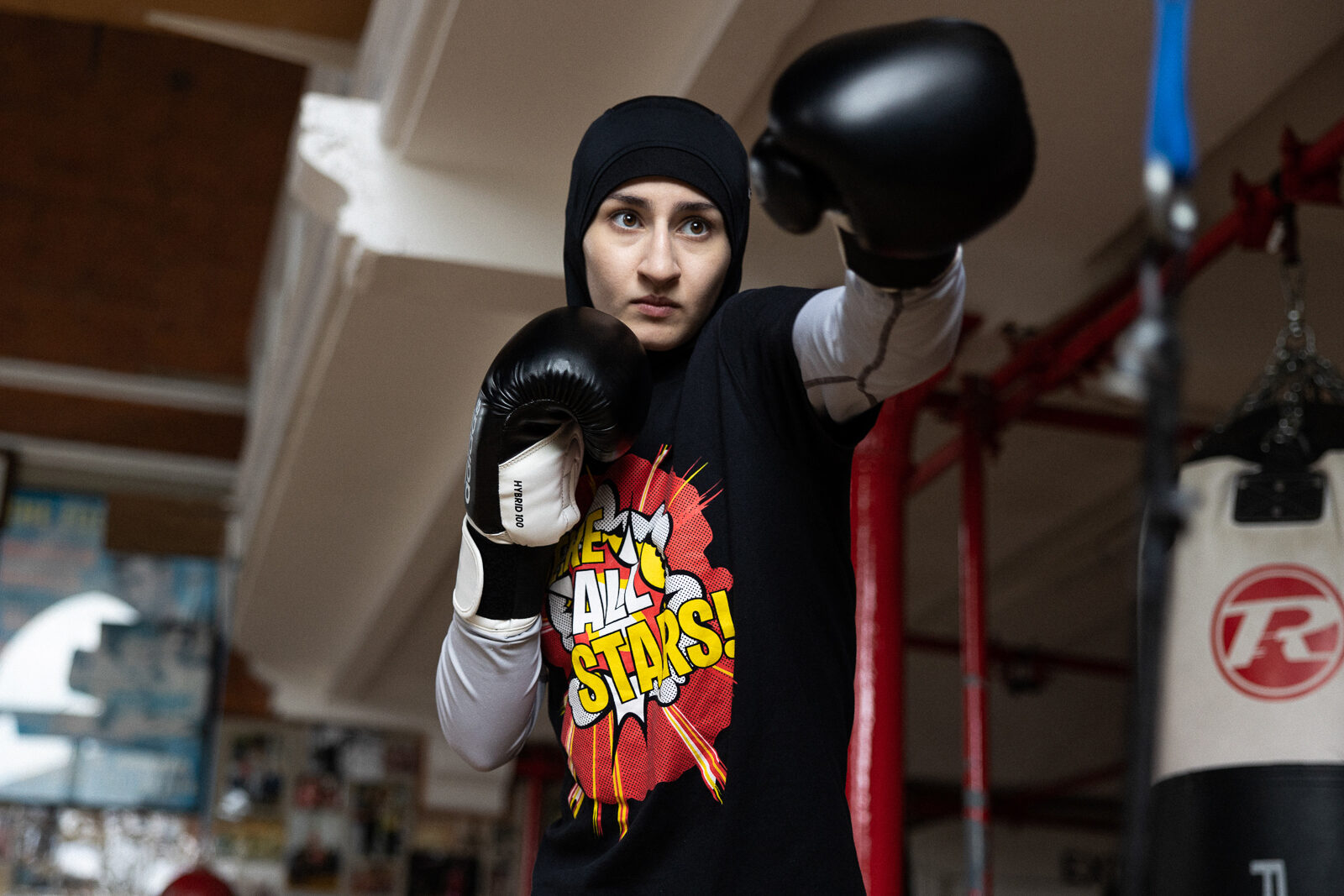
“Boxing is a sport where you have to put everything into it, you can’t mess around. The whole purpose is to strain yourself and to push your limits. For anyone who wants to get into boxing, you have to go through that. I hate running, I hate taking ice baths, but I have to do it because it’s the sport I love. After this, I really don’t want to do sprints. But I know if I want to become champion, I’ve got to do it.”
Azim credits that mindset to his father, who was determined to keep him away from crime after one of his own brothers was murdered. “My dad always said, ‘Stay off the streets, and never put yourself in the position your uncle was in.’ So I listened and I got here because of him.”
He also wants to quit boxing young while he still has his health. “The more time you’re in this sport, the more danger there is,” he says. “After that I just want to live my life, invest well, have children and put them in good schools.”
He does admit that he would also like to try his hand at acting, though. “I’ve always wanted to get into it and I do try, but I’m not the best. Hopefully I’ll learn over the years,” he says. “I’ll probably get tips from Dúaa.”
Adam Azim’s bout with Steve Claggett will be live on BBC Two and BBC iPlayer from 8:30pm on Saturday 30 May.