
‘Years of buried pain left my body at once’: how breathwork helped me through grief
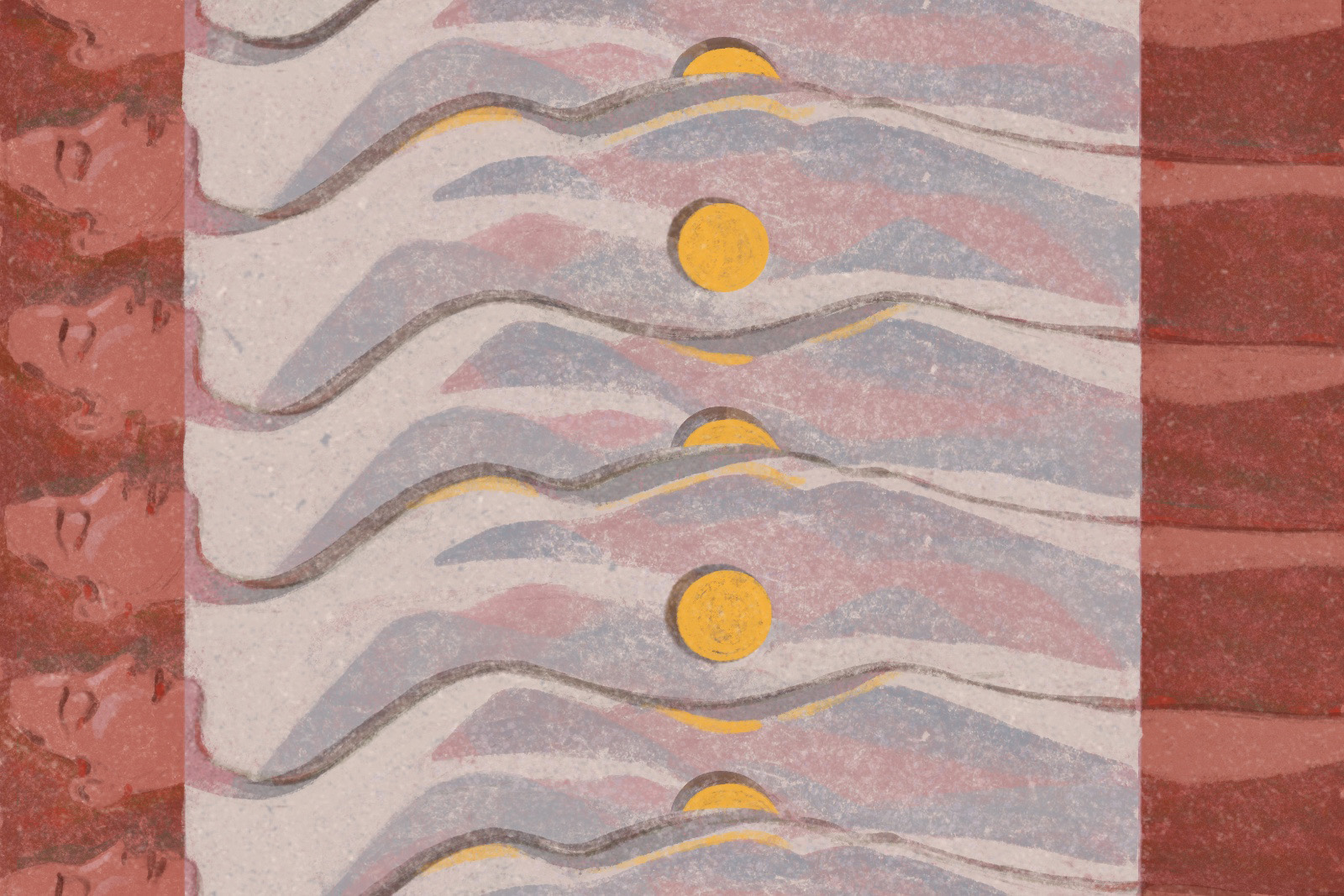
Life happens somewhere in between the millions of breaths we take, carrying us from one moment to the next, carrying everything we love and everyone we’ve lost
The path to Natalie Keany’s studio feels like crossing into another world. Just metres from the glass towers and traffic of London’s Southbank is a pocket of improbable greenery, where palms, bamboo and flowering trees soften the Victorian brickwork. It was there, in January 2025, that I came to meet Keany, a breathwork practitioner and trauma-informed facilitator.
An old friend had spoken about her sessions with Keany in the way people speak about life-changing books or pilgrimages. “You should try it,” she told me. “Something will shift.” Though I wasn’t quite sure what needed shifting.
I pressed the buzzer, climbed the narrow staircase and found Keany waiting at the top. Sitting beside each other on recliner chairs, we talked. About life, about who we are and who we were, the state of the world, the weather. About the reasons people seek healing, even when they cannot quite articulate what hurts.
Eventually, she suggested I lie down on a mat in the centre of the floor.
There was nothing dramatic or mystical about it. Just breathing. It sounds absurd that something we do 20,000 times a day could become a practice, a portal into ourselves. Breath enters. Breath leaves. Breath returns. It accompanies us through every ordinary moment of our lives. While we mindlessly scroll, mindfully work. While we rush for trains and while we sleep. Most of the time we barely notice it, until suddenly, we do.
Related content
The pandemic changed that. For months, breath became headline news. We watched people struggle for oxygen, counted ventilator shortages, followed infection rates and death tolls. Something we had always assumed would continue, indefinitely, revealed itself to be fragile. Breath had become visible.
In the years since, it has undergone something of a cultural renaissance. Breathwork workshops now fill studios and Zoom rooms. Meditation apps guide users through carefully timed inhalations and exhalations. James Nestor’s bestselling book Breath argues that modern humans have forgotten how to breathe properly, linking it to everything from sleep and anxiety to performance and longevity. Breathing, it seems, has become something we are now trying to relearn.
For me, that rediscovery began during the pandemic itself. Each week, around 80 people from around the world joined a programme called A Year to Live, run by the California-based Rumi Educational Center via Zoom. The premise was simple: live this year as though it might be your last. It sounds morbid, but it wasn’t. If anything, it felt clarifying.
Together with strangers who slowly became friends, we reflected on mortality as a certainty rather than an abstraction. Some sessions involved guided deep belly breathing exercises We imagined, however imperfectly, that the number of breaths remaining to us was finite.
The experience left me with a question I’ve kept returning to in the years since: what is spiritual breath?
As Muslims, we encounter breath almost immediately in the story of our own creation. The Qur’an describes God fashioning Adam and then breathing His spirit into him. Life begins with a breath. Classical scholars are careful to explain that the ruh (the spirit) is a creation of God rather than a literal part of God Himself. Yet the symbolism still holds something of awe. The transition from clay to consciousness happens only through breath. We move from stillness to life, from earth to awareness.
The Arabic word nafas means breath and comes from the same root nafs, the self. Some Muslim mystics spoke of Nafas al-Rahman, the Breath of the Merciful, through which existence itself unfolds and is sustained.
Perhaps that is why it occupies such a charged place between the physical and the spiritual.
Years before I met Keany, I had encountered breath through dhikr. A French convert aptly named Noor (Divine Light) shared a simple practice while connecting to our creator. She would inhale with “Allah”, and exhale with “Hu”. Allah. Hu. Allah. Hu. Her fingers slowly glided along the wooden beads of her misbah, one bead for each breath. I began noticing how often breath accompanies remembrance and how spirituality, at its root, might simply be a matter of paying attention.
Now, sat in Keany’s studio as she guided me into the opening minutes of the session, I was paying attention again.
She encouraged me to breathe through my mouth, at my own pace. Then, following her voice, to inhale deeply and exhale without pause. My mouth grew dry, and every so often I would run my tongue across the roof of it and continue.
The rhythm felt unnatural at first. Then it became the only thing that existed.
Keany later explained that breathing continuously through the mouth can temporarily alter blood chemistry, creating tingling sensations, vibrations and, in some cases, altered states of awareness. It can also quieten what neuroscientists call the default mode network — the part of the brain associated with self-reflection, analysis and control.
When that gatekeeper softens, she told me, memories sometimes rise to the surface. The body remembers things the mind has carefully filed away.
My hands had begun to tingle. Tiny currents of electricity flickered through my fingers and forearms. Then my feet, my legs. The sensations spread and dissolved. The room seemed to move further away, while the floor beneath me softened. My awareness narrowed until there was only breath.
And then, without warning, I was back in 2017 again.
Some years pass quietly. Others divide your life into before and after, a border you cross without realising it, until you’re already on the other side.
Before 2017: certainty, family life, a much longed-for child, and the quiet miracle of becoming parents. Like so many couples, Omar and I had imagined parenthood as the fulfilment of a family. And it was. But dreams have a habit of arriving wrapped in realities no one quite prepares you for. Omar worked shifts, often at hours that made us feel like we inhabited parallel worlds. We crossed paths in the kitchen, exchanged hurried updates and promised each other that things would settle down eventually.
There would be more time later. For travel, for rest, for ourselves. For each other.
Then illness arrived, and later never came.
Omar was one of those people who seemed larger than the space he occupied. Tall and athletic, with hazel-green eyes that could flash with mischief one moment and tenderness the next, and a voice like gravel softened by sips of warm coffee. He moved through the world with an ease I both admired and marvelled at. Years of martial arts training had given him a quiet confidence that never needed announcing. He could be stubborn, headstrong and gloriously unconcerned with what other people thought.
But beneath the bravado sat an enormous capacity for love. Especially for his family, for our son.
Martial artists spend years learning to control their breath — to regulate it under pressure and to find stillness in chaos. Looking back now, I’m certain Omar understood something about breath long before I did.
He took his last breath on the final day of that year.
And now, almost a decade later, lying on a mat in Keany’s studio, I was crying for him. Not the dignified tears of an adult. These came differently. They felt warm and thunderous, like monsoon rain.
For years I had carried my grief carefully. I had learned to live around it, to keep moving, to tell the story of what happened to Omar without touching its raw centre. I had learned to speak about his death with a kind of practised steadiness that people often mistake for having healed. But now the breath found that centre immediately.
Related content
It felt as though years of buried pain were leaving my body all at once.
Again and again I heard myself apologising to Omar, for not saving him, for not finding the right doctor, the right treatment, the right miracle. For all the ways grief convinces us that love should have been enough to keep death away.
And then, something began to shift. It was gradual. Arriving with a warmth, like the feeling of being held, and a deep and unmistakable sense of safety.
I only know it felt as though Omar was there. As though he had always been there, just beyond the noise, and I had finally tuned in.
The unnamed heaviness I had been carrying for years hasn’t disappeared entirely, but it no longer feels lodged beneath my ribs. Grief seems less interested in hiding. I sleep deeply and it feels restorative rather than functional. My dreams can be vivid, cinematic almost. Omar appears often, as does our son, as living presences inhabiting landscapes that feel somehow, more real than this ordinary life. I wake feeling strangely peaceful, as though someone had quietly opened a window in a room I hadn’t realised was suffocating.
The first thing we do upon entering this world is inhale and the last thing we do before leaving it is exhale. Life happens somewhere in between in the millions of breaths we take mostly without noticing, carrying us from one moment to the next, carrying everything we love and everyone we’ve lost. We breathe in. We breathe out. And somewhere in that space, we are still learning to return.