
Family fear politics will prevent justice in Bologna police death
Relatives of Abderrahim Fakir, who died after being restrained, warn that political backing for officers risks undermining the inquiry

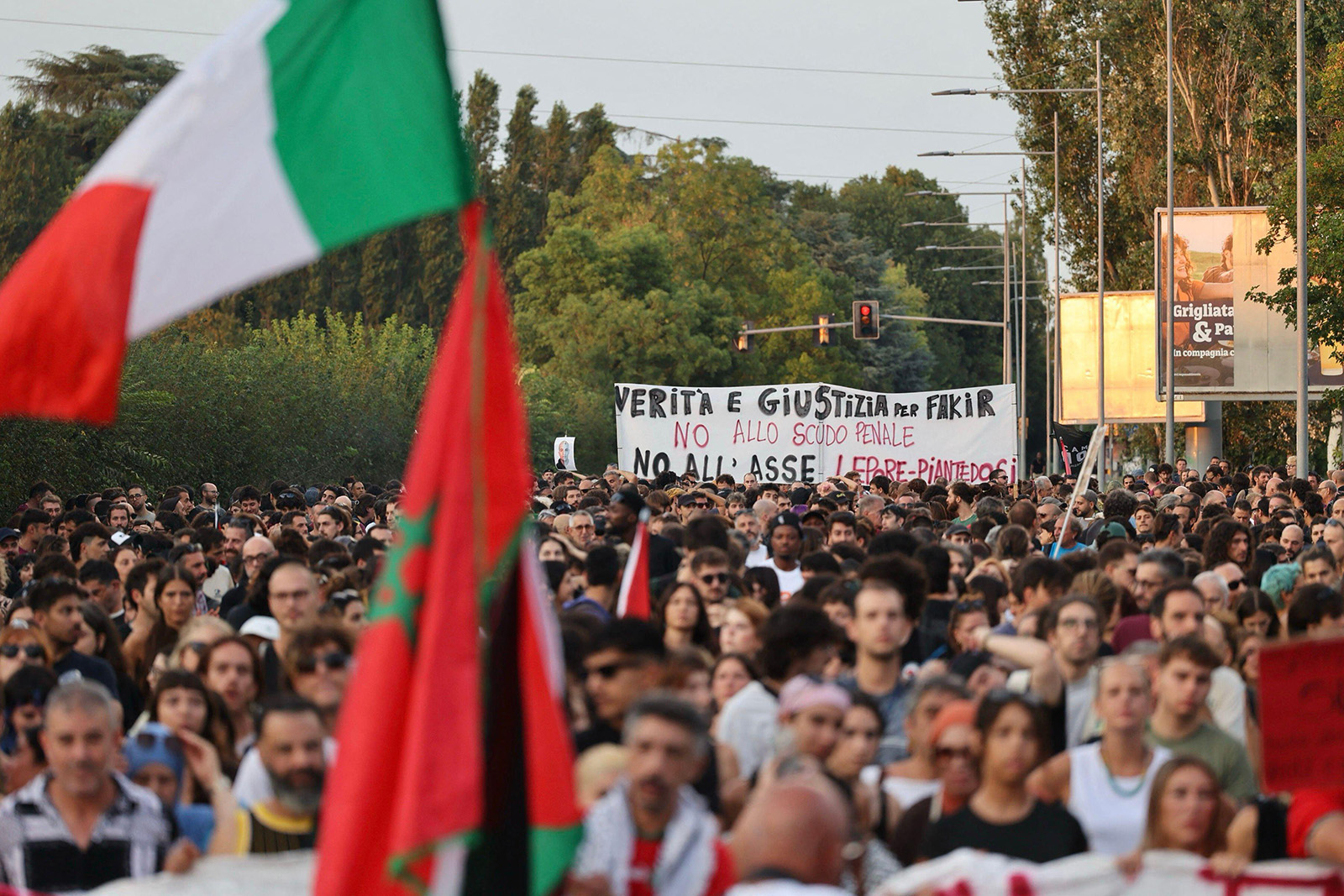
It’s a warm Sunday evening in the residential neighbourhood of Pilastro in Bologna, Italy, and a group is gathering at Via Italo Svevo. A banner, painted in red and black, lies at their feet: “Truth and justice for Fakir — we are all Fakir.” On a nearby post, the flags of Palestine, Morocco and Italy hang together.
The vigil is taking place a week after 42-year-old Abderrahim Fakir died here on 19 July while being subdued by police. A video published on social media shows Fakir — a Moroccan-born resident of Bologna educated in Italy — held down on the ground by two police officers and a third person at his feet. He screams for help before groaning and falling silent.
Related content

Fakir’s death is currently under investigation by Bologna prosecutors. But as his family awaits more information and certainty, their lawyer, Fabio Anselmo, says that the political climate is already hindering a transparent investigation.
“Based on the autopsy results, but also on the video showing the end of Fakir’s life, it seems clear that there is a violent mechanism of compression and asphyxiation,” Anselmo said. “But what kind of atmosphere are the experts working in when, every other day, ministers and police chiefs are going to Bologna to show solidarity with the officers?”
In a crowdfunding campaign for legal fees set up by the family, Fakir’s niece, Yossra, wrote that their “only wish is for the circumstances surrounding what happened to be fully clarified, respectfully and through all the investigations and assessments that the judicial authority considers necessary”. More than €25,000 has already been raised.
Fakir was a legal resident in Italy. His immigration lawyer, Barbara Spinelli, confirmed to Hyphen that he had completed his schooling in Italy and was running a business in Bologna specialising in carpentry, welding and metalwork. But a criminal record from his early 20s — drug-dealing offences and the violation of a house arrest order — had complicated his residency situation. He had applied for special protection, which can be granted in Italy for foreign residents who have been integrated into the country for a long time. In the months leading up to his death, Spinelli says, he was increasingly anxious about his immigration status.
“Unfortunately, this is the game of the goose and the fate of many foreigners with criminal records,” she said in an interview with Hyphen.
Before he died, Spinelli remembered that Fakir “felt this deep anguish and fear” that he would be deported, in part because of the recent EU pact on migration and asylum.
“I reassured him, and I even made a joke about it, to ease his deep anxiety,” Spinelli said. “Then to learn that he had died right in the hands of the police whom he feared would deport him has killed me as well.”
At the protest on 26 July, an estimated 2,000 people marched peacefully through the Pilastro neighborhood, calling for justice and condemning what one speaker called “torture documented on video”. One woman in a hijab watching the start of the protest did not wish to discuss Fakir’s death with reporters. “The pain is too great and we’ve talked too much. We want to see action,” she said.
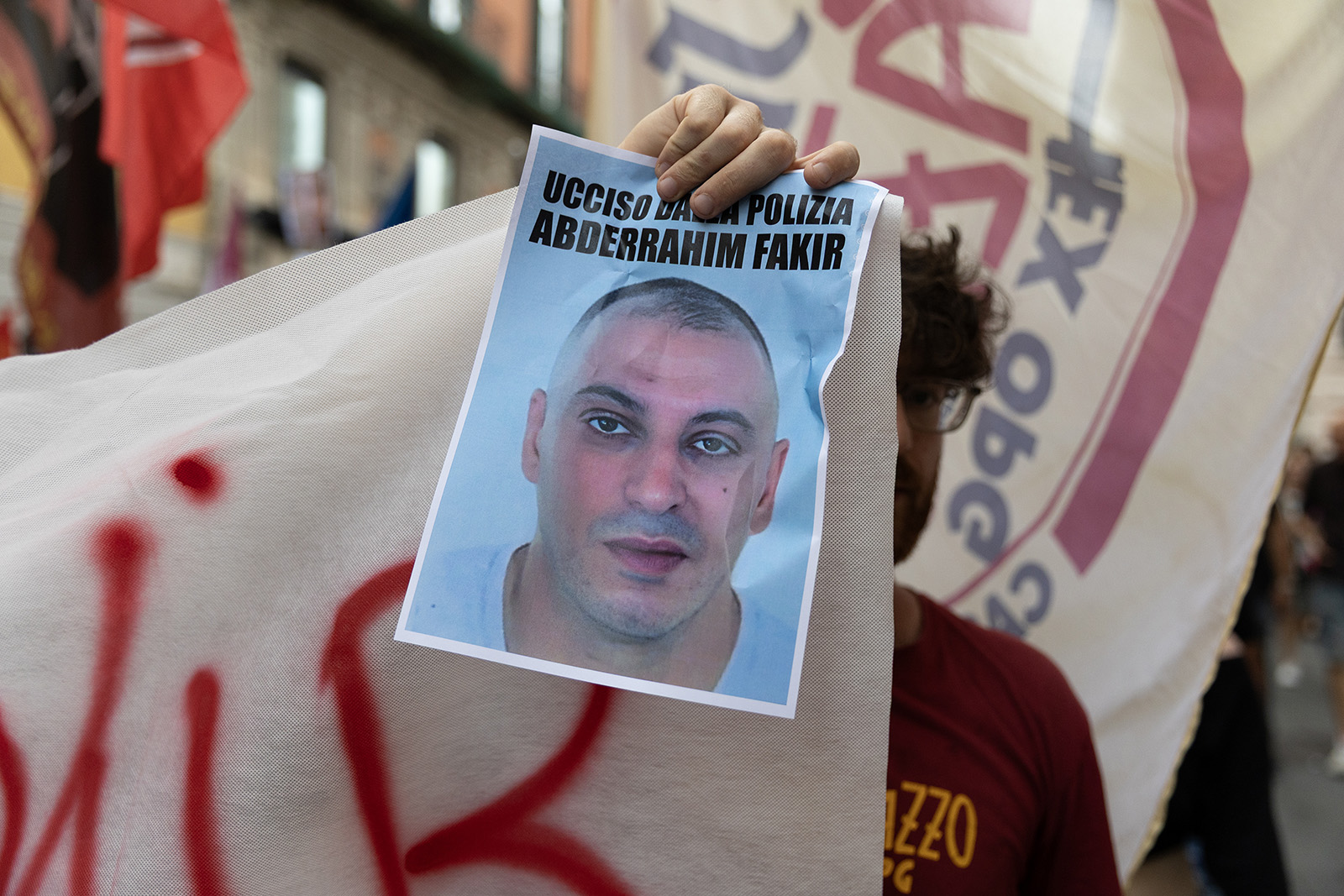
Before the march began, protesters took a moment of silence and knelt in the square, fists held high, a gesture referencing George Floyd — a 46-year-old Black American man whose murder by a police officer sparked massive protests across the globe against systemic racism and police brutality.
What is known about the events that led to Fakir’s death has been pieced together from police and health authority official reports and witness videos.
Police were dispatched to Pilastro on 19 July after residents reported “a person on a rampage,” according to the Bologna police department. In a call to the 118 emergency health hotline, a caller described a “foreigner screaming and kicking all of the garage doors, yelling for help and that they want to kill him”. A statement from the Italian Red Cross said its volunteers “intervened immediately after the police officers’ intervention” and carried out CPR until a medical vehicle arrived when they confirmed Fakir’s death.
According to autopsy results published by Italian media late last week, the presence of fresh blood in Fakir’s lungs is consistent with compression.
But a lawyer representing the police involved in the incident told Hyphen that, based on the footage he reviewed, he believes no violence was committed by the officers.
“From the combination of all these images, I reach an unambiguous conclusion that points toward completely excluding any act of violence and chest compression,” Gabriele Bordoni said.
“There’s no moment in which the police officers are on top of him with any part of their bodies, holding him pinned to the ground or pressing him to the ground in a way that would obstruct or make it difficult for him to breathe.”
Italy’s strict — and often controversial — immigration laws have been criticised by human rights groups. Legislation passed in 2002 requires all immigrants to have fingerprints taken when they apply for or receive residency documents, and unlike many European countries, children born or raised in Italy to non-Italian parents are not automatically granted citizenship but have to apply for it at the age of 18.
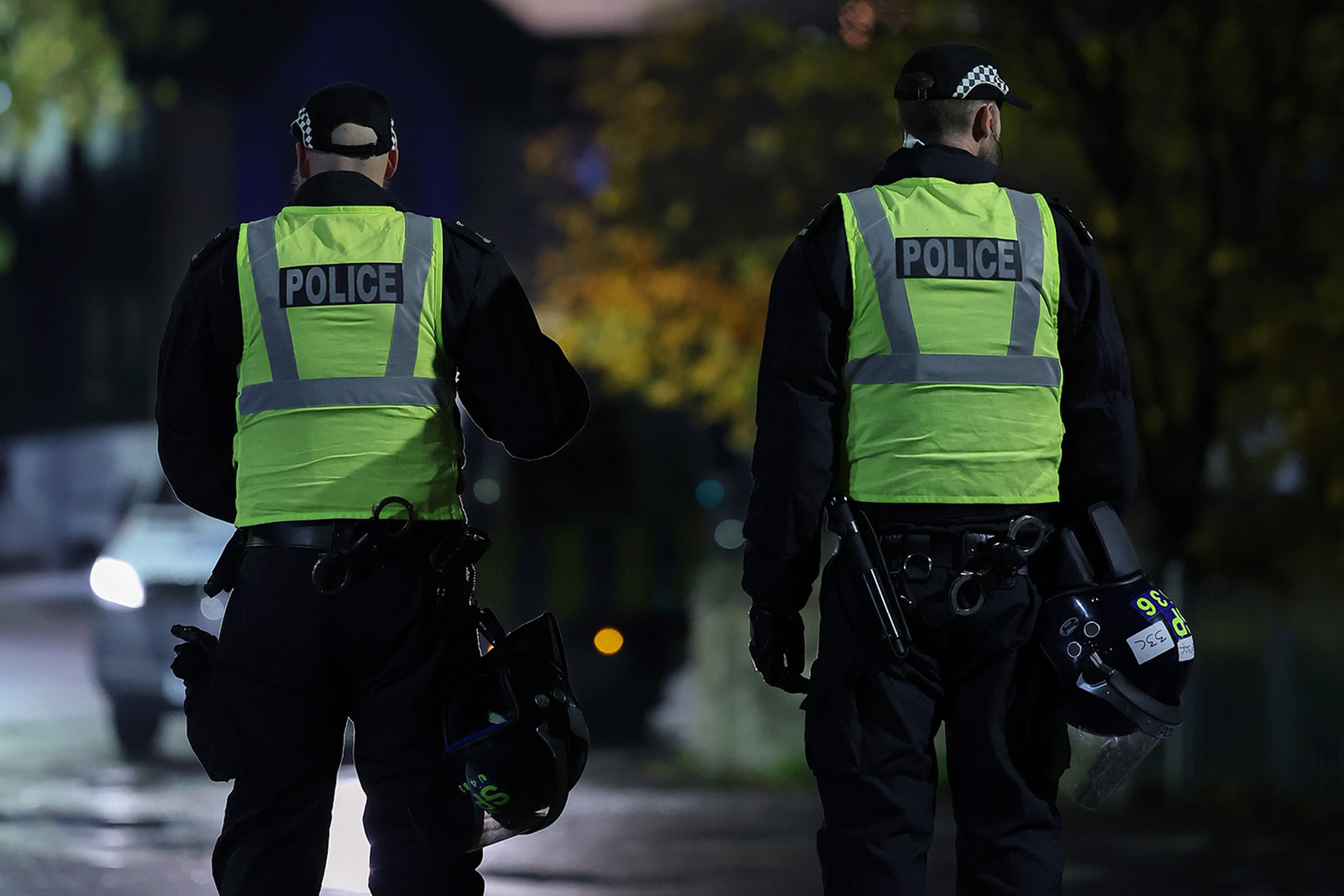
The day after Fakir’s death, longstanding tensions over these policies boiled over as protesters met in Bologna’s historic centre for an event Mayor Matteo Lepore described as a “moment of gathering and participation”. The demonstration eventually led to violent skirmishes with the police. In a press release, the Bologna police department indicated that 64 officers had been injured.
Related content

As tensions rise, senior Italian politicians have weighed in. In an interview with Italian TV station La7, minister of the interior Matteo Piantedosi, who oversees the Italian police, claimed: “Police officers approached with the sensitivity, gentleness and consideration that the complexity of the case required in these circumstances and, after that, they activated the necessary containment when things appeared to deteriorate.”
After the violent protest in Bologna, prime minister Giorgia Meloni released a statement on Twitter calling what had happened in the piazza “unacceptable” and adding that “on the death of Abderrahim Fakir, it’s essential that the eventual responsibility be discovered with the maximum rigour. The truth must be completely searched for, without prejudice and without letting anyone off.”
Anselmo isn’t convinced. He believes the case was effectively decided before the investigation could begin. A forensic medical report is already in progress. Bordoni, for his part, has faith in an impartial judiciary.
“This has become a matter of state, where the government has decided that he had to die this way — and that’s just fine,” he said.
“When every day a government official exonerates the officers, I turn to the family at this point and ask: what are we doing all of this for? I have never seen such severe interference in the judicial process.”