
The legacy of the World of Islam festival, 50 years on
In 1976 London hosted a three-month-long programme showcasing art and culture from the Islamic world — the first of its kind and on a scale that could not be replicated today

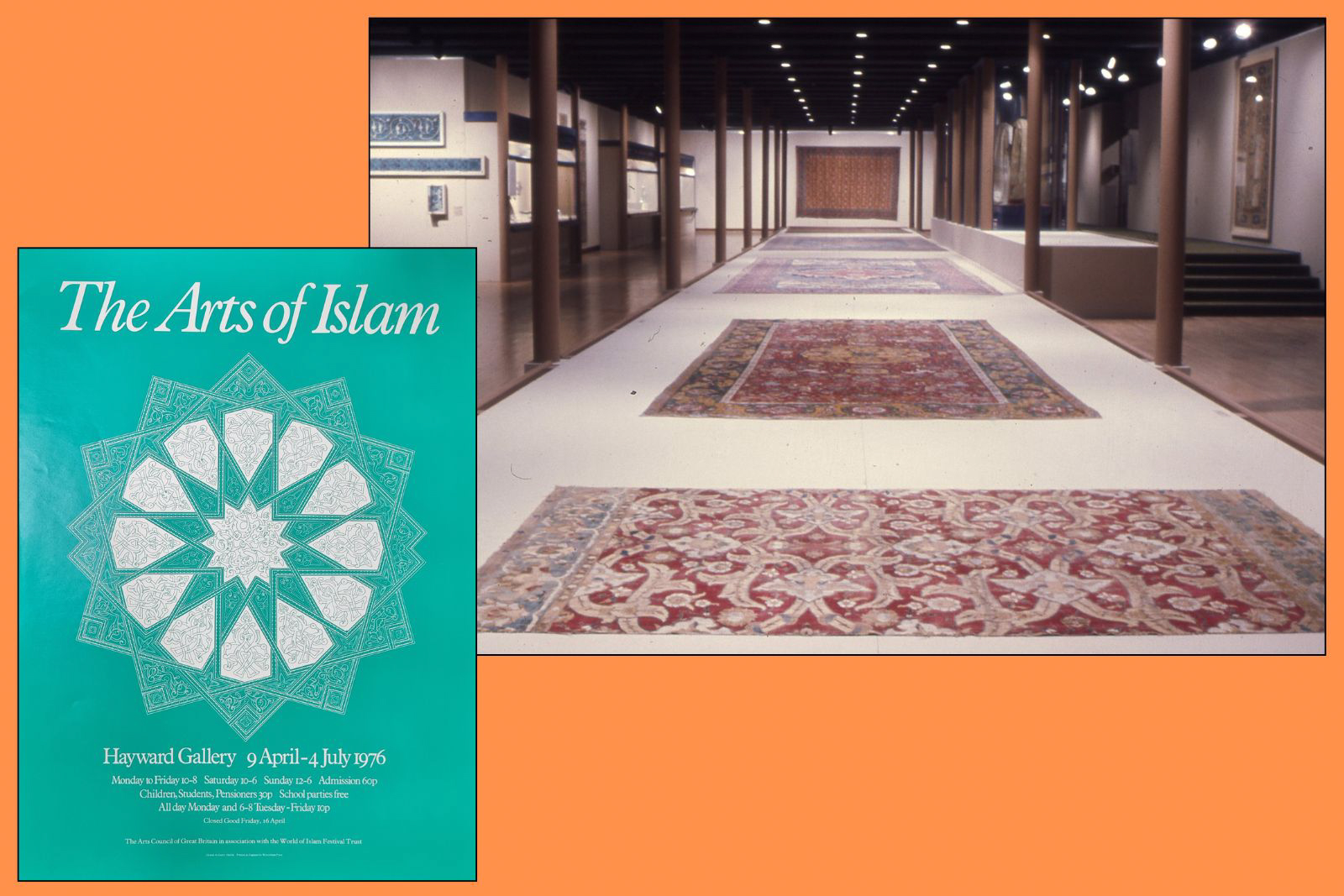
On 8 April 1976, the Hayward Gallery in London’s South Bank hosted the opening of an event of unusual scale: the three-month-long World of Islam Festival. Queen Elizabeth II inaugurated the programme, which took place across the capital and in a number of institutions around the UK. She was accompanied at the ceremony by the Archbishop of Canterbury and the sheikh of Al-Azhar University in Cairo. Concerts, lectures, performances and museum presentations followed, bringing together more than 2,000 objects and works of art from the Islamic world, on loan from 250 public and private collections in 30 countries.
“Such an attempt had never been made before — and probably could not have been,” wrote John Sabini in the June 1976 issue of Aramco World magazine. “It is only in the 20th century that technology has enabled scholars in distant lands to reach each other swiftly, to find, pack and transport thousands of rare and delicate treasures.”
The British Museum held a display of more than 140 Quranic manuscripts from the ninth to the 19th century, among them early Qur’ans written in Kufic script on vellum. There were also late medieval manuscripts in the Mamluk and Timurid styles, and examples of Ottoman and Safavid calligraphic art.
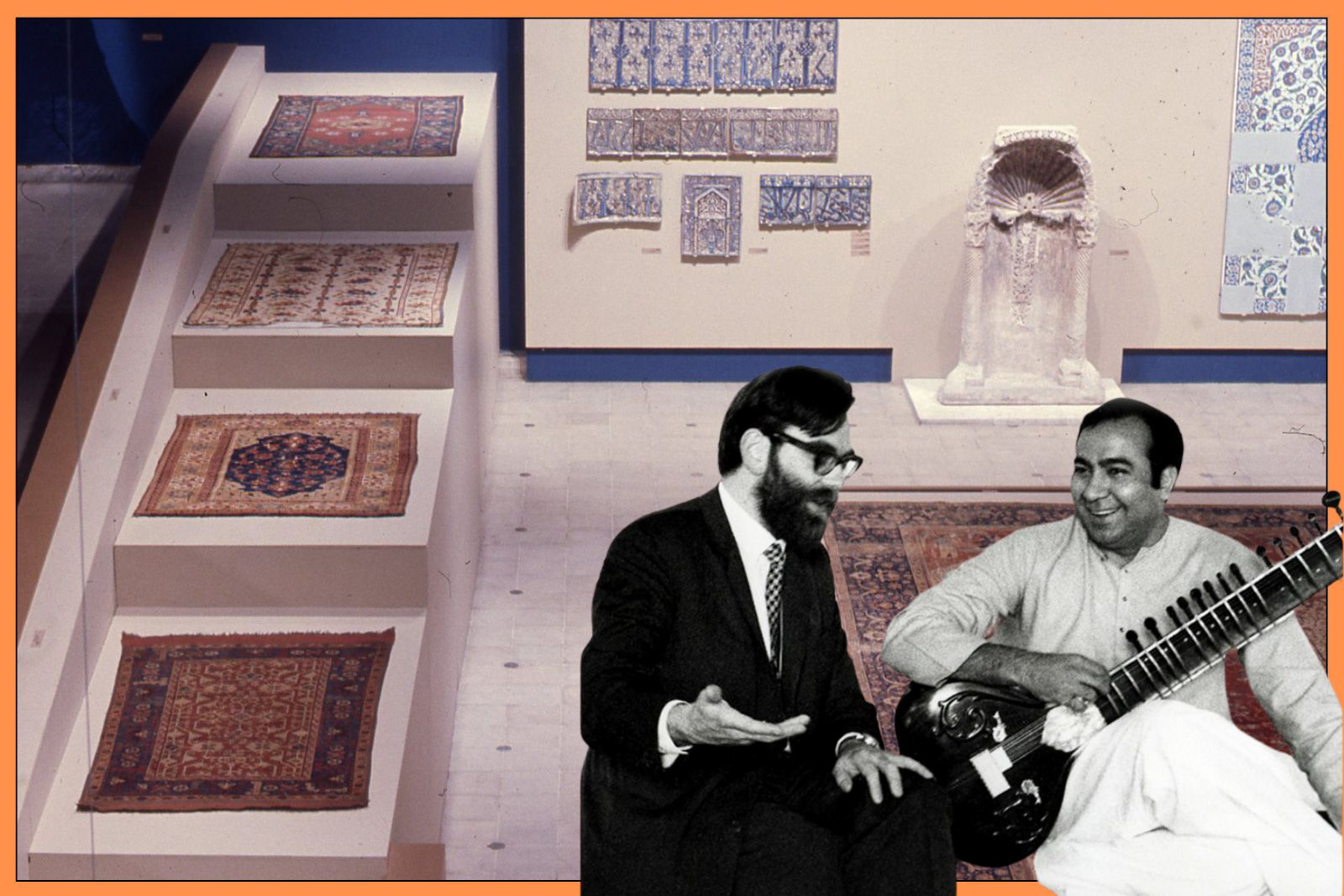
Elsewhere, exhibitions showcased Bedouin settlements and urban ways of life in Fez and San’aa, displays of metalwork and Hausa textiles, Persian carpets, and a performance by ghazal singers from Pakistan at the Royal Albert Hall.
The driving force behind the festival was its then 34-year-old director, Paul Keeler, a gallerist in London. Keeler’s interest in Islamic art stemmed from an encounter in the late 1960s with Ustad Mahmud Mirza, a maestro of the sitar and Hindustani classical music.
“My entry into the world of Islam was quite extraordinary, because it was through a great master of traditional music,” Keeler tells me. “The person I met was a living exponent of an Islamic traditional art form which was completely intact.”
In 1968, influenced by his interactions with Mirza, Keeler organised a small exhibition at Brandeis University in Boston titled The Mughal Way of Life, followed by the Arts of Islam Festival, a 1971 exhibition at the Institute of Contemporary Arts in London. Both were precursors to the events of 1976, born of Keeler’s desire to showcase Islamic art on a grand scale, as one unified tradition.
Much of the funding was provided by Gulf countries, primarily the United Arab Emirates, flush with wealth following the oil boom of the early 1970s, while institutional support was guaranteed from the Arts Council. Keeler recalls amassing £2.4 million. “I just had a vision of this glorious art. You couldn’t stop me. I would have walked across red hot coals to get to the end.”
But, he says: “There’s no way we could do it today. Fifty years ago, the scholar, the professor, the curator, the librarian, they were the kings. They made the decisions.”
“On a practical level, the resources required to mount something on that scale would be enormous,” says Daniel Lowe, curator of Arabic Collections at the British Library. “The sheer number of object loans that featured in the festival’s exhibitions would be extremely challenging — if not impossible — to secure today, both for geopolitical and financial reasons.”
In 2016, Lowe and Nur Sobers-Khan, a curator and researcher of Islamic manuscripts and art, organised a panel event with the Everyday Muslim Archive to commemorate the festival’s 40th anniversary. Both were intrigued by its legacy, particularly its impact on how Islamic art and heritage have been displayed in cultural institutions since.
The festival “was an incredible undertaking”, Sobers-Khan says. “Even for major exhibitions in the UK [now], it’s hard to find the funding to do that. There’s no ambitious cultural vision any more for anything, much less for Islamic art.”
In recent years, academic critiques of the festival have centred on its perceived lack of outreach to British Muslim communities and its traditionalist framing of Islamic art, which positioned it as constituting one homogenous civilisation.
“I admire the scale and the beauty of the vision, although I don’t fundamentally agree with its principles,” Sobers-Khan says. “The naivety is a relic of its time. A bunch of primarily male curators in national institutions, presenting exotic, beautiful images to the public.”
The festival emerged, Lowe says, in the context of the decline of the British empire, growing western interest in eastern spirituality during the 1960s, and the 1973 oil crisis, which saw an increase in the funding of cultural heritage projects as a form of soft power. “It preceded two major shifts that would fundamentally reshape discussions around Islam and representation in the west: the publication of Edward Said’s Orientalism in 1978 and the Iranian Revolution in 1979,” he says.
Lowe suggests that the curatorial framework of the festival would not be an appropriate model to replicate now, shaped as it was, in large part, “by traditionalist ideas that sought to present Islam through a unified spiritual and civilisational lens”.
Instead, a contemporary reimagining might be more polyvocal and self-reflexive, more attentive to questions of diaspora, migration, identity, class, race, politics and the legacy of colonialism, centring “the voices and lived experience of Muslim communities themselves”, Lowe says.
Outreach and community engagement, Sobers-Khan adds, are newer concepts in museology, which would not have been at the forefront of the curation at the time. “We weren’t overwhelmed by marketeers and PR people and all this jargon,” Keeler says. “I don’t think I would have ever heard the term target audience. There was simply ‘the audience’.”
Despite such critiques, the festival still signified a shift of sorts. Presenting Islam to the public with the backing of major government institutions through culture, art and music was “quite radical”, says Hassan Vawda, a scholar at Goldsmiths University of London. “Curators were still focused on just creating strong exhibitions for the core audiences, so I think there’s a caution to what expectations to place on the festival from our position now, and to think about it in the context of 1976,” he says.
At the time, historian and author Jan Morris wrote in the Times that the festival’s publications evaded “the less soothing aspects of Islam: its frequent fanaticism, its taste for war, its subjection of women, and its often barbaric atavism”. In a letter to the editor, one reader condemned the press’s enthusiastic reaction. “I find it offensive that it should be possible for Islamic countries to mount the World of Islam Festival here without any hint of criticism for their deeply oppressive treatment of women.”
Yet other press coverage highlighted the uniqueness of the “beautiful and unknown” objects on display “never before seen” in the west. One organiser told the Times that he hoped the festival would “help break stereotyped images”. Reader Abbas Kelidar described the event as representative of a new attitude: “What has prompted the Muslim world to stage the festival of Islam seems to be the realisation that their civilisation can stand on equal footing with that of Europe.”
For Keeler, the impact has been lasting. In 1975, in the months leading up to the festival, he became a Muslim and adopted the name Ahmed. “I was the last generation that was educated for the empire. I went through the whole empire grooming, or the empire indoctrination… by the age of 14, I was a little empire builder,” he tells me.
That identity gave him a sense of wholeness, he says, until his generation’s rebellion against hierarchies in the 1960s shattered it. Islam represented a new “world of perfection” that made him feel complete again. “And I wanted to be a part of that. I wanted to be whole.”
One day in June, towards the end of the three-month-long programme, Keeler was at the British Museum, where he noticed an older man weeping in front of one of the large Mamluk manuscripts on display as part of the Qur’an exhibition. “Why are you crying?” Keeler asked. The man explained that he had come from Manchester every weekend to visit the exhibition so that he might look at the Qur’ans again. “And next weekend, they won’t be here,” he told Keeler. “They’ll have gone.”