
Revealed: asylum seekers placed in housing that poses ‘imminent safety risk’
Data from Home Office and local councils reveals dozens of critical hazards found in ‘dispersal housing’ that is run by private firms for profit

Home Office and local council staff sent to inspect controversial “dispersal” housing for asylum seekers and their families have found dozens of hazards so serious that they pose an “imminent risk” to tenants’ safety, data obtained by Hyphen reveals.
Collapsed ceilings, damp and mould-ridden homes, overcrowding, vermin infestations and excess cold are among the issues affecting people — including children — who live in the properties, which are run for profit by firms including Serco and Clearsprings.
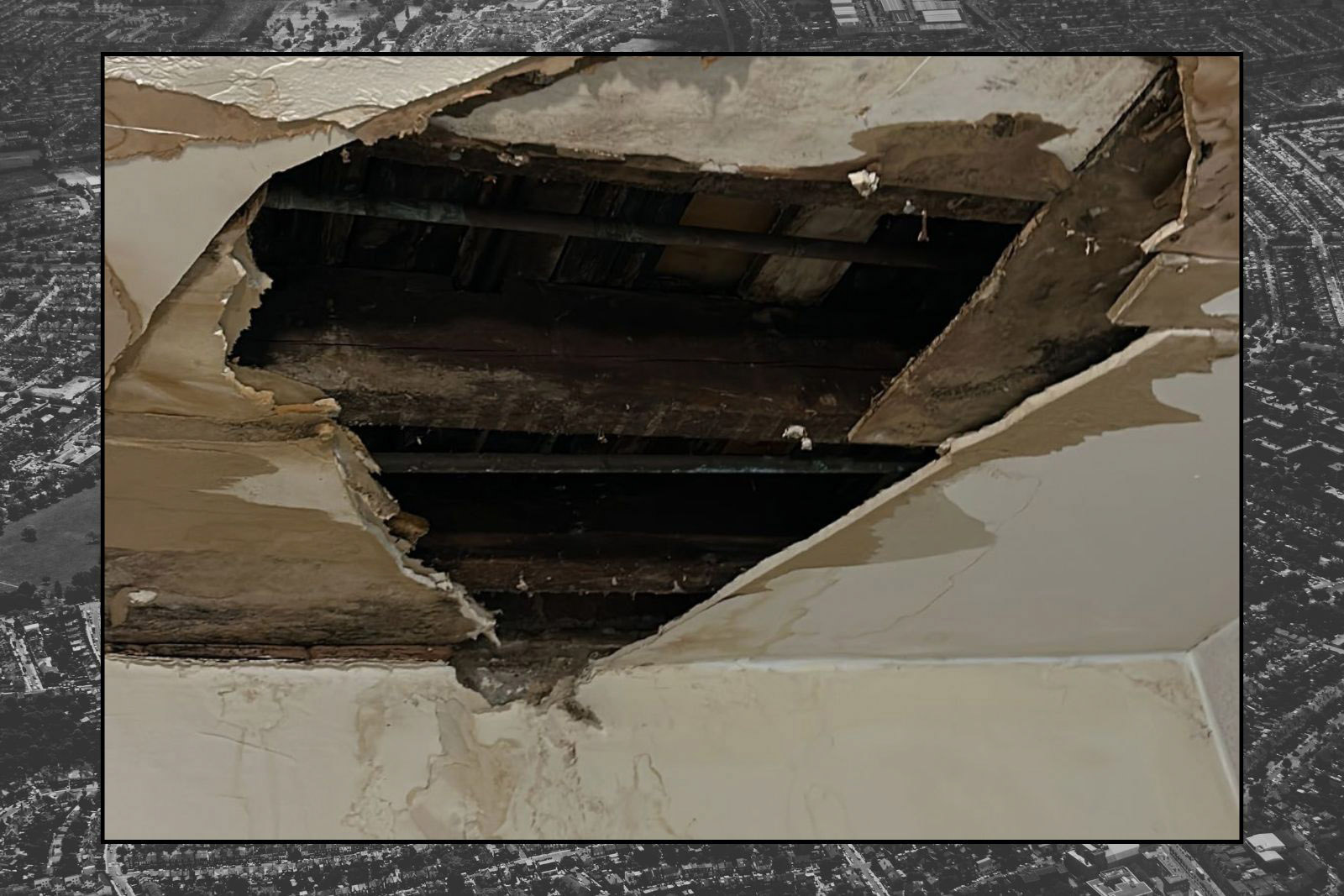
Photos of one such property show a large hole in the ceiling of a house in Greater London, run by Clearsprings, after it collapsed in 2024. The Helen Bamber Foundation, the human rights charity that shared the pictures, told Hyphen that a survivor of human trafficking had been living at the property, and that the lengthy wait for it to be fixed had taken a “huge physical and mental health toll” on them.
Former Labour leader Jeremy Corbyn said Hyphen’s “distressing findings should bring eternal shame to the outgoing government” of the ousted Keir Starmer, claiming: “They will be remembered for dereliction of duty toward some of the world’s most vulnerable people.”

He called on Andy Burnham, the new Labour leader and prime minister, to extend Awaab’s law and the decent homes standard to protect asylum seekers. Corbyn added: “The hostile environment never ended and it is beyond disgraceful that asylum seekers are treated with such contempt and inhumanity… they are human beings with human rights too.”
What is Awaab’s law?
Awaab’s law came into force for the social rent sector in October 2025. Taking its name from Awaab Ishak, a two-year-old boy who died in December 2020 after exposure to mould at his Rochdale home, it requires landlords to investigate and fix all potential emergency hazards, including damp and mould, within strict fixed timeframes.
The government plans to extend it to the private sector through its Renters’ Rights Act — giving tenants the power to report non-compliance to an independent ombudsman and, ultimately, to take landlords to court for breach of contract — but not to asylum housing.

London Councils, a representative body, told Hyphen that asylum seekers are too often placed in unacceptably poor housing, with limited routes to raise concerns or get support when things go wrong. This risks creating a “two-tier system”, it said, adding that consistent standards and access to an independent ombudsman would drive up quality and ensure dignity and fairness.
Zoe Dexter, housing and welfare manager at the Helen Bamber Foundation, said people seeking asylum “don’t have the money, tools or authority” to fix serious housing issues but are “often left living in these conditions for months or even years”.
“As more and more people are moved into dispersal accommodation from hotels, this is affecting more and more people,” she said. “With stronger oversight of accommodation providers and basic support when people are dispersed, much of this harm could be prevented.”
The Home Office inspects asylum properties managed by three private firms — Clearsprings, Serco and Mears, all of which have regional contracts until 2029 — to check they meet key targets of being safe (category 1), habitable (category 2) and fit for purpose (category 3).
Its teams carried out 6,458 inspections of initial and dispersal accommodation for asylum seekers from 1 January 2025 and 17 December 2025, inclusive, freedom of information (FoI) data obtained by Hyphen shows.
Related content

They found 21 category 1 maintenance issues, defined as defects that have, or are likely to cause, a risk to health, safety, or security, or disruption or loss of an essential service of the accommodation. Half of these were at Clearsprings properties in the south of England.
Inspectors also identified 1,342 category 2 defects, which may cause an adverse effect on health, safety or security.
The Home Office can fine providers unless they fix issues within set timeframes or provide alternative housing. But the department “lacks the capacity to comprehensively inspect accommodation” and has been “over-reliant on self-reporting of performance by providers”, MP have warned. It reportedly aims to inspect just 25% of dispersal homes annually.
Councils sometimes inspect dispersal properties too, often to check if houses in multiple occupation (HMOs) are compliant with the licences held by their landlords.
But many dispersal properties aren’t HMOs, so won’t be subject to these inspections — and councils often “lack the resources and capacity for regular inspections, managing only to conduct reactive inspections when issues are reported”, warned Refugee Action, a charity.
Nineteen councils responded to FoI requests from Hyphen asking how many dispersal properties they had inspected between 1 January 2024 and 31 October 2025, and what issues they had found.
They completed 741 inspections, with 15 councils between them finding 42 category 1 hazards, defined as posing a “serious and immediate risk” to residents, seven of which related to damp and mould.
Families were living in some of these properties.
Among them were Ikram and Salah, a young couple seeking asylum with two young children, who asked us not to publish their full names for fear it could put them at risk.
They told Hyphen they had shared a damp, mouldy bedroom with the children, aged one and three, at a dispersal property in Suffolk for eight months.
“It’s so stressful,” Ikram, 30. “The damp is very dangerous, especially for the children.”
Councils also flagged 846 category 2 hazards, which are less urgent but do pose risks.
Clearsprings was approached for comment.
On Tuesday, Hyphen revealed that asylum seekers and other people were being put at risk by failures to provide adequate psychological care to those placed in dispersal housing.