

Muslim divorce is rising. Pre-marriage bootcamps could change that

Talaqs, conflict resolution and ‘Alpha Muslims’: how marriage schools with very different ideologies are trying to influence young couples
At Aina Khan’s City of London legal firm, the Islamic family law specialist regularly meets Muslim couples seeking a divorce. “It’s non-stop,” she said. “Divorce is very common now. Sometimes the marriage breaks up within a few weeks.”
The Courts and Tribunal Service does not record the religion of divorcing couples, but people on the front line such as Khan believe the failure rate of Muslim marriages is on the rise.
“What’s risen in the younger Muslim demographic is this disposable culture whereby you can have everything you want immediately,” she said. “It’s like Amazon delivery service — you put in your criteria of what you want and it’s delivered, and if it’s not exactly what you want, you return it and you get a refund. It’s almost like that with marriage now. The stigma of divorce has gone.”
Related content
But there is another trend, whose leaders hope to reverse the first: the rise of Muslim marriage training, at which participants learn Islamic law and interpersonal skills. Hyphen has found 16 Muslim organisations in Britain that have run these courses or workshops in the last year; six were set up in 2021 or later.
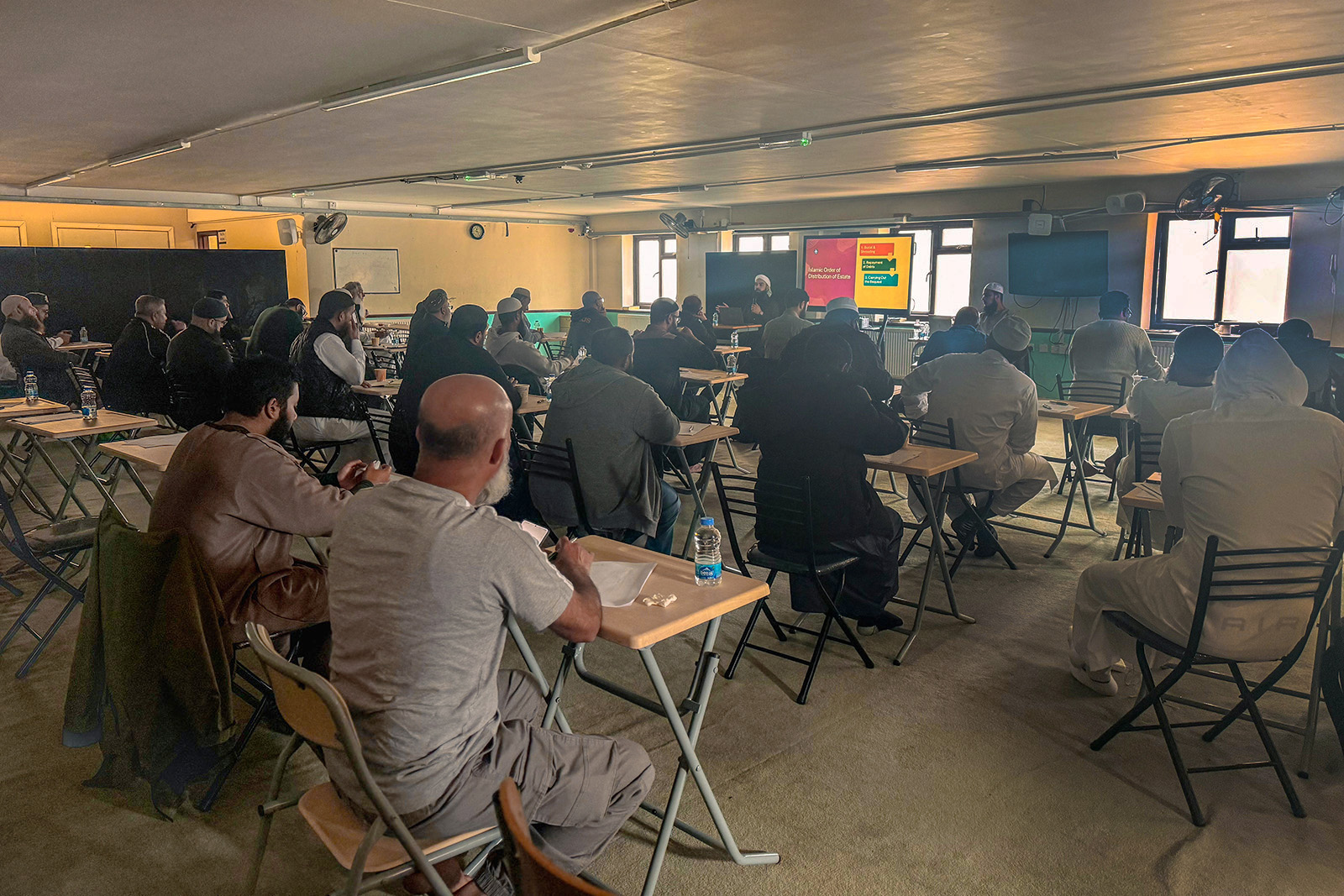
Qualified marriage counsellors Shaykh Muaaz Vahora and Shaykh Zubair Patel founded the Muslim Family Foundation (MFF) in 2022 and run their one-day workshop at mosques and community centres around the UK. Their goal is to equip Muslims with the emotional intelligence and understanding of marriage needed before a nikkah (the signing of the Islamic marriage contract).
“Muslims who have grown up in the west sometimes have a fairytale understanding of marriage,” said Vahora. “We try to help people understand that marriage is not always perfect and take away these false narratives that we absorb from what we see in movies and on social media.”
Combining guidance from the Qur’an and sunnah with modern psychology and research, the pair teach practical steps for balancing different cultural pressures — such as expectations about relationships with in-laws — with the requirements of Islamic marriage, as well as how to share and balance responsibilities. They also offer a free online crash course.
Pre-marital education covering both religious and legal rights and rules is not new: it has been mandatory since 1996 in Malaysia. Divorce rates there hit a record low four years later, with about one per 1,000 couples. But in recent years, the number of divorces has started to climb. Some say the course is outdated, hindering its effectiveness.
Muslim clerics in Britain say most divorces in the community take place within two years of marriage, citing a generational shift whereby couples give up at the first hurdle instead of working through their problems.
Past approaches to educating Muslims on marriage in Britain have focused too much on Islamic law while neglecting the psychological and emotional aspects of a marriage, says London-based couples counsellor Ayesha Aslam, the founder of Sakoon.
Related content
She and her team run a six-week pre-marital course where Muslims learn how to communicate and manage conflict in marriage in a healthier way.
“There’s a lot of self-development,” she said of the course content, “because many people tend to focus on the other person. They’re not necessarily looking at themselves and whether their intention is correct when it comes to marriage.”
Aleena* from Bradford, a 26-year-old stay-at-home mother, took Bradford Muslim College’s 10-week marriage course shortly after she and her husband got engaged in 2021. She said it “definitely had an impact, especially in the early days”. “There was a shift after we did the course,” she said. “We felt quite confident in ourselves and felt: ‘We know what we’re doing’.”
Aleena and her husband were reminded that, in Islam, if a husband says he wants a divorce three times — known as a talaq — the marriage is dissolved.
“It helped having that knowledge, because you’re not quick to say things or jump to divorce,” she said. “We were told you have three talaqs and it’s done — you can’t joke about it.”
The Muslim manosphere
Alongside content online that idealises marriage, young couples must navigate a new generation of rightwing, anti-feminist influencers such as Jordan Peterson and Andrew Tate, and the “trad wife” movement, a group of conservative female influencers advocating for supposedly “traditional” gender roles within relationships and society. These movements, believes Aslam, can negatively affect some Muslims’ views towards marriage by framing it in terms of duty and power instead of love and connection.
Within that sphere of rightwing influencers is what has been called a “Muslim manosphere”, whose big names include British internet personalities such as Imran Mansur, AKA Dawah Man, Mohammed Hijab and Ali Dawah — all of whom have been blamed for fuelling online misogyny within Muslim communities.
Another key figure is controversial American da’i Daniel Haqiqatjou, who is now running his own “marriage school” for Muslims. In April, Haqiqatjou — whose YouTube channel The Muslim Skeptic has more than 450,000 followers — led a four-day retreat in Istanbul organised by his company Global Ummah Retreats. Enquiries and bookings for the event, at which men and women were taught separately, were advertised via a UK telephone number, although no one answered when Hyphen called.
Previewing the retreat, Haqiqatjou promised to teach men how to “defend your home against feminism”, which he has often blamed for the breakdown of Muslim marriages. In a video on the retreat website, he added: “A lot of those who claim they’re teaching marriage advice based on the Qur’an and sunnah are just regurgitating feminist principles and feminist advice that will destroy your marriage if you follow it.”
Global Ummah Retreats previously ran an “Alpha Muslim 2.0” course in Turkey in May 2024 in collaboration with Gabriel Romaani, another well-known figure in the Muslim manosphere, who claims he teaches “peak masculinity” according to the Qur’an sunnah.
“From both an Islamic and therapeutic perspective, I have concerns about marriage courses that promote ‘alpha male’ frameworks as the ideal for Muslim marriages,” said Aslam. “While Islam encourages leadership, it is rooted in responsibility, mercy, and mutual consultation — not dominance or control. The Prophet Muhammed modelled compassion, emotional intelligence and partnership, which can be overlooked in more rigid alpha-style narratives.
“In my work as a systemic therapist working with individuals and couples, I often see that overly simplified gender roles can create unrealistic expectations, increase power struggles and discourage healthy communication.”
The MFF was the subject of a similar complaint lodged by the National Secular Society (NSS) to the Charity Commission in February 2025, claiming it had published social media posts that “promoted subordination of women”. The posts in question have since been taken down and Hyphen could find no evidence of this theme in the charity’s online marriage crash course.
Asked directly about the complaint, Vahora suggested the NSS had cherry picked “certain statements from videos” and reached “erroneous” conclusions, though he conceded that the social media content had been outsourced and published without proper oversight. “Our views have always tried to balance between the genders because that is what Islam teaches and is in the best interest of marriage harmony,” he said. The regulator took no action against MFF other than issuing guidance about oversight of social media posts produced by external contractors; MFF says it has introduced stricter review procedures as a result.
West Yorkshire marriage counsellor Khalid Hussain — who runs one-to-one pre-nikkah courses through the Muslim Marriage Counselling Service alongside his wife Bochra Hussain — echoed this sentiment.
“One of the most common issues we get is where you have a professional couple, for example, a pharmacist marrying a dentist, and the question is whether they both continue working,” he said. “There’s nothing in Islam to say she needs to stop working. That’s a decision they need to make as a couple.”
*Name changed to protect individual’s privacy