
Tahmina Begum’s Womanhood: exclusive extract
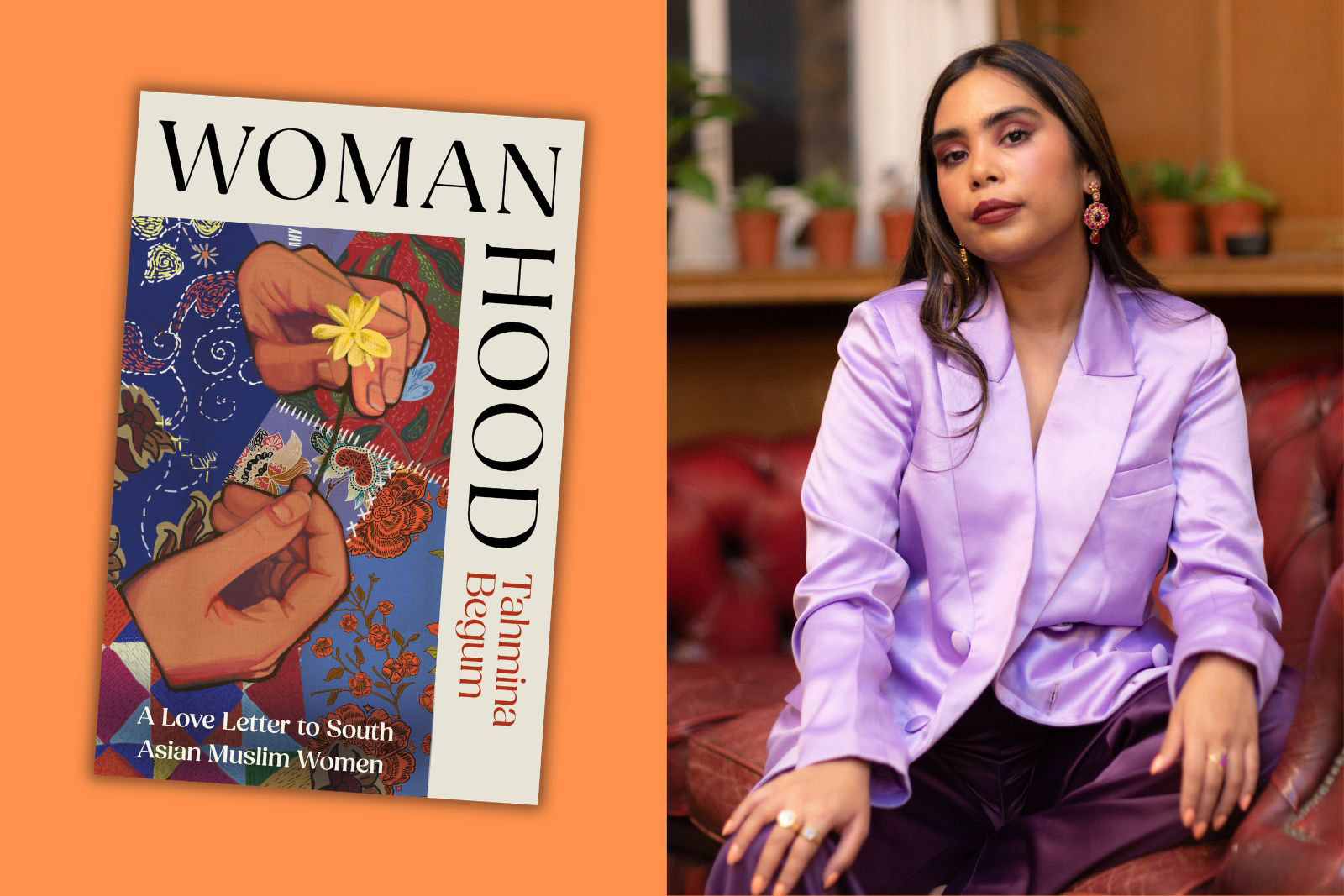
Starting in 2017, the author chronicles the hopes, dreams and experiences of three South Asian Muslim women in the UK. Their stories are told in her new book

Womanhood, a new book by journalist and author Tahmina Begum, offers a searching and empathetic look into the lives of ordinary South Asian Muslim women in the UK.
Navigating the fault lines between tradition and modernity, each of Begum’s three subjects have stories to tell that are both relatable and enthralling. Here, we present an exclusive first extract ahead of publication later this year.
Noor
Noor was hosting an art exhibition at a distinguished London gallery. The night promised art curated through a Muslim female lens. The pieces mixed mediums and were by artists who had attended art schools around the world, some making their cities their playground. There was a dark room with thick cream rugs to sit on, where visitors could watch a compilation of short films by Sudanese female film-makers on a loop. There was a Palestinian poetry class in session somewhere in the hundred-year-old building and qawwali singers reverberating their devotion.
Late in the evening, a rush of footsteps entered the gallery as groups of mostly young Muslim women clustered together. The reception area had a faint smell of bleach, sanitary like a hospital, with added scents of vanilla and warm ylang-ylang. Most of the people who arrived wanted to support Noor and what she stood for, while also ensuring that their social media audience was aware of their presence that night.
Related content
At events like this, among people like these, women were becoming visible for all to see. The gallery looked like any other — white and open — and was located in the heart of disrupted, marginalised communities. Down the road stood a central mosque, fruit stands for passers-by to inspect, and a hundred and one restaurants with cuisines catering to a hundred and one tongues.
However, because this was Art, the exhibitions were frequented by those who were merely a sampling of the patchwork streets outside. Those same cobbled, tarmac and concrete pavements spoke for the medley of people. Noor had not grown up in east London like many of her Bengali peers, so she had only seen gentrification unfold at arm’s length, watching local Indian restaurants transforming into bubble tea joints and cafes selling rainbow-coloured bagels.
But that night, the exhibition and the space were “reclaimed”, so it felt right that Noor wore a simple, thick, mocha-brown shalwar kameez with no embroidery, echoing what her ancestors would have worn while migrating through Afghanistan into East Bengal during the Silk Road trade. Her shoes were leopard-print suede mules. The bag was handcrafted by a Gulf-based designer. Care was in the details so that night was about Islamic excellence — even down to the tailoring.
Unlike most days at the gallery, the receptionist was checking in millennial and gen Z women wearing satin slip dresses with matching tonal hijabs, their streamlined make-up likely to inspire the next hit teen TV show. These women made layering look as though it belonged to the elite. There wasn’t a type of woman who wasn’t in attendance — from the feminine to the gender-defying, from the visibly Muslim to the ones who had applied gemstones around their eyes, audaciously, on the tube ride there. A performance in glamour. This night was for Muslim women, by Muslim women, with the addition of a few supportive and allied friends.
Yet, like most times in Noor’s life, she was performing, hosting and, mostly, tired. What looked like a put-together event had taken over six months of coordinating with head gallerists over the “right” and “appropriate” themes that would suit both a typically white-owned gallery and its Muslim attendees.
There had been multiple conversations with events producers about selecting Muslim-owned food and drink vendors for the night, and Noor herself had assembled the gift bags that waited by the door. She’d sat in her front room, cross-legged in a mehndi-coloured maxi dress, with piles of black ribbon to feed through the bags on one side and a pile of gifted beauty products on the other, all while her family watched The Great British Bake Off, unable to resist comparing all new contestants to the incomparable Nadiya Hussain.
Noor’s apple-shaped cheeks gave way to a welcoming smile, but her closest friends knew better. They were the ones who could see beyond the tall ceilings and the shiny approval from other impressionable young women. Her eyes lacked her usual 90s-era brown eyeshadow, although she had found time to apply mascara in order to appear wide awake. I half-jokingly asked if she was high and she laughed as if to say she wished so but simply replied, “No, bro, I’m just really tired.”
It wasn’t just the literati who knew that the best events were those that appeared seamless but took the longest to curate. Even for this brief opening night, for an exhibition that would last three months, Noor and her team had thought about everything — from the DJ set to the different activity rooms, where Muslim women could collectively sit and sew, or create a sculpture inspired by a Rumi poem picked from the centre of the table. Hours had been spent deciding which mocktails would pair best with the “open library” available at the exhibition. The thoughtfulness was appreciated. Young women were not born serving; they were kneaded into place. It was what their mothers and grandmothers had been doing since the beginning of time, in their own ways, in their own homes.
This was no different from Noor’s mother organising a family gathering and feeding no fewer than 50. The only difference was that, in the morning, it would be Noor infusing the pomegranate into the lebu pani by hand while also ensuring the oven was set to the right temperature for the roasted chicken.
South Asian and Muslim homes like Noor’s were homes where it didn’t matter who knocked; the door was always open because, most of the time, someone was always at home, awaiting unexpected guests. The desire to go for a walk, run an errand at the corner shop or see a friend was put on pause. Mothers and grandmothers like Noor’s would take down the white and blue china teacups from the top cabinet shelf for anyone who walked through the door. The ebony wooden showcases, stacked with cutlery and tableware, were only opened for “special occasions”, with groceries bought for invited guests days in advance. These unspoken expectations — ancient love languages that treated strangers like family — were still ingrained in “modern” women like Noor. For they were always expected to be present externally, no matter what was happening internally.
Women like Noor, who embodied the new world as well as the ancient one, had the voices of many different women inside. All women who raised Noor, and also those she could relate to, who took their turn sharing how a woman should be in life. It made Noor well-rounded but it also drove her insane. For the longest time, before their children became like the people they were raised among in this cold country, work was not a priority for South Asian women, especially not in the face of guests.
That was, until their fathers and husbands had to leave halfway through the evening to head to jobs where they drove drunk strangers around in the middle of the night or served dishes that catered to watered-down, entitled palates. This wasn’t the case for Noor’s father. He worked a senior office job where he could speak fluent English and experienced adventurous away-days, which meant he understood Noor’s need for rest over the weekend. He understood why she preferred to visit Moroccan hammams instead of a stressful visit back to Bangladesh for holidays, and why a work Christmas dinner was always a delicious dinner to opt into, even if it meant being in a traditional pub. It meant, in comparison to her friends, she was an inch more seen by her parents.
Their lives, for the longest time, were not entirely experienced apart. “How was your date?” Noor asked an attendee who smiled even more broadly, delighted that Noor had remembered something from weeks ago. Women did not fall from the sky, Noor thought; she had been doing this her entire life. Young Muslim women lingered, hoping to catch a moment with Noor, and she knew this. She asked kindly, “Did it take long for you to get here?”, “Do you guys need anything?” and even, “Do you know where you’re going?” — as if she were the doorman and not the founding curator.
Perhaps this was what set Noor apart from the white gallerists — she never had to be sought out; she was a part of the crowd, unlike a second-generation Muslim woman who felt the duty to throw the ladder back down. The duty was ever-present on Noor’s face, as though she alone had to correct the biased histories displayed within these high ceilings and white walls.
Girls and women told her she was an inspiration, and Noor simply threw her head back, waved away the compliment with her French-tipped gemstone nails, and responded humbly: “Oh, please, anyone could do this! You could do this!” It wasn’t true, but it was the right answer. An exhibition targeted at Muslim women wouldn’t work if the attendees didn’t feel that their aspirations were within reach. But as she glided through the room and caught Tobias’s glance, she knew this was the one place where she didn’t have to perform. As Noor walked towards him, she saw him finishing a conversation with a couple of guys whose backs were turned.
Tobias reached for the mantelpiece behind him, grabbing the drinks he had been holding for Noor. “Here, this is for you. Did you find Zarifa? How are you getting on?”
Noor took a sip of the innocent orange and pink concoction and realised this was the first time all night someone had thought of her first. As a curator, people assumed it was glamorous to be in charge, to create spaces for young women to aspire to, yet Noor could never admit how exhausting it was to always think five steps ahead without seeming ungrateful.
This was the first time all night someone had thought for her before she had to. Tobias always had a way of looking after her. Perhaps this was because their souls had already met in the heavens.
Womanhood will be published by Trapeze on 5 November, priced £22.