Golders Green attacks must not be used to usher in a new era of surveillance
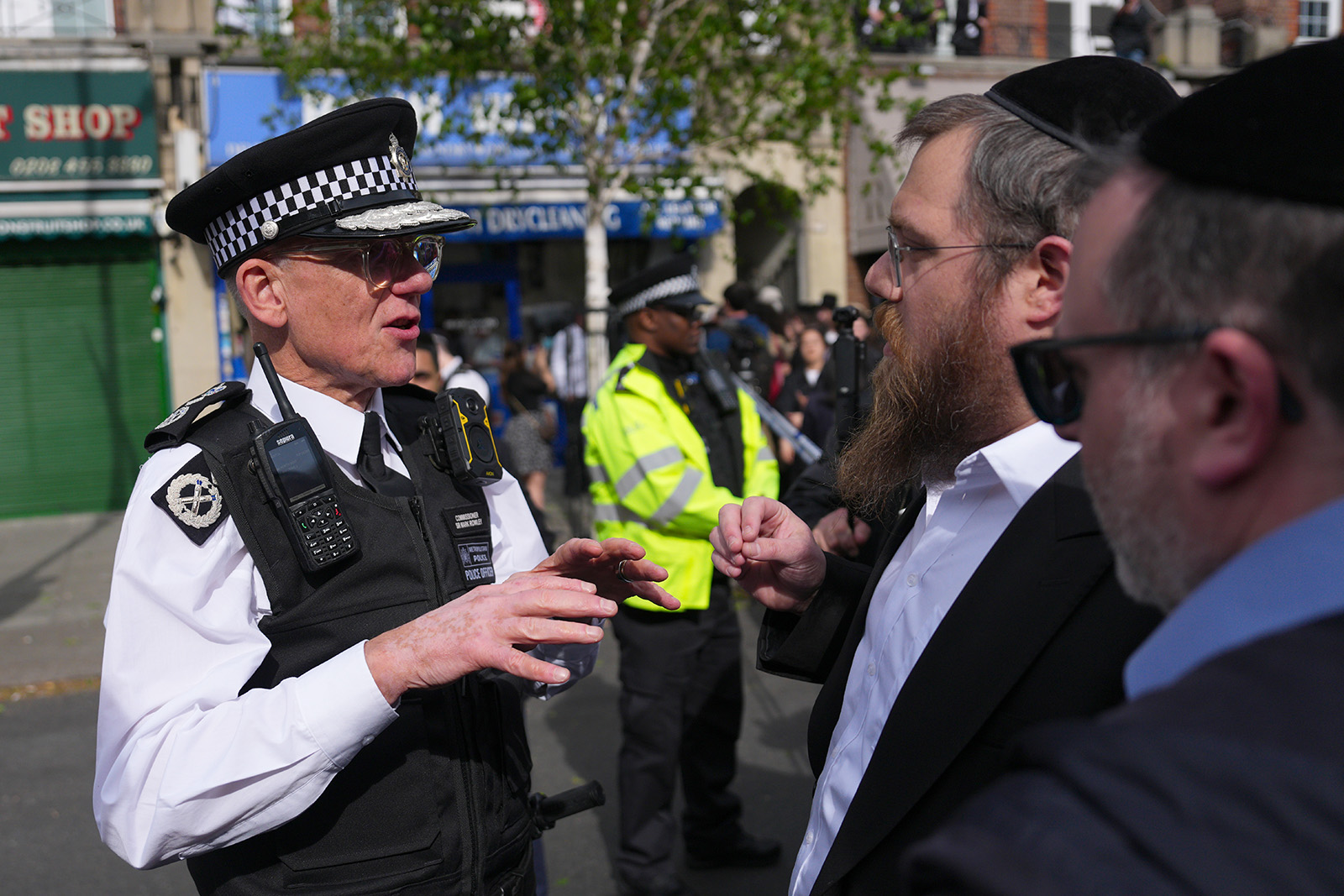
The stabbing of two Jewish men in north London requires honest analysis. Instead, commentators are reaching for the usual convenient suspects
The attack on two Jewish men, Shloime Rand and Moshe Shine, in Golders Green this week deserves unequivocal condemnation. It also deserves honest reporting and analysis within the constraints of British media law. What it has received instead, across significant stretches of British media and political nexus, is something closer to a campaign that seeks to exploit a horrific incident, deployed with striking speed.
A suspect, Essa Suleiman — who is also accused of attacking another man, Ishmail Hussein, earlier the day of the Golders Green stabbings — has now been charged with attempted murder. But commentators had drawn their own conclusions about the causes of the attacks even before Suleiman had appeared in court.
Take, for instance, an interview with Tim Jakes, the newly appointed Prevent commissioner, by presenter Justin Webb during a segment about the attack on Radio 4’s Today programme on Friday. Webb stated at one point that William Shawcross, after his own review of the much-maligned anti-radicalisation scheme in 2023, had “felt there was too much of an emphasis on the far right and not, as he would see it, a proper emphasis on the people who really were potentially being radicalised in much larger numbers, and those were Islamists”. When Jakes did not directly address this claim, Webb asked him again: “Do you accept… that it has had in the past the wrong emphasis, has emphasised too much the far right and not enough Islamists?”
When the architecture of a question already contains its answer, you are not watching journalism. You are watching activism dressed as inquiry.
Related content
This is what has been taking place across newsrooms in Britain. Sky News asked former MP Louise Ellman if action against antisemitism promised by the home secretary was “enough”. She responded by calling for greater scrutiny of “Islamic incitement” and “what is happening within our mosques”. Both broadcaster Adam Boulton and Reform UK MP Robert Jenrick have separately claimed since the attack that Labour has been reluctant to challenge Islam for fear of losing Muslim votes. Add to this the calls to proscribe pro-Palestine marches — which attract people from all backgrounds, including Jewish people — and we have a political campaign, not a fight against genuine antisemitism.
A lot of it is based on falsehoods: for example, shadow home secretary Chris Philp has insisted on the BBC and ITV that the word “intifada” is a call for violence against the Jewish people, when it in fact means rebellion against the oppression that the Palestinian people continue to suffer. Meanwhile, on Talk TV, one supposed extremism expert claimed, unchallenged, that Muslims believe that “Israel must be removed for the second coming of Muhammad”. There is, of course, no second coming of the Prophet in Islam, but accuracy does not seem to matter at the moment.
There is a striking contradiction at the heart of this coverage. Journalists and public figures — ITV’s Robert Peston among them — are insisting that Jews must not be conflated with Israel, that treating Jewish citizens as proxies for a foreign government is itself antisemitic. That principle is correct.
Yet many of the same voices calling for the curtailment of pro-Palestinian expression and Muslim civil liberties are doing precisely the opposite. Even left-liberal publications are hosting arguments where it is suggested that opposition to the Israel Defense Forces or solidarity with Palestinians is evidence of a threat to Jewish people in Britain.
You cannot coherently demand that Jews are not collapsed into Israel while insisting that criticism of Israeli military conduct constitutes hostility to Jews. That is not protecting Jewish people, but rather conscripting them into a political argument.
Related content

The Centre for Media Monitoring, where I work as a researcher, has documented this pattern in detail. These are not isolated editorial misjudgments. A violent, awful attack whose causes have not yet been established has already become the occasion for a sweeping cultural and security indictment of Muslim communities, Palestinian solidarity movements and even Islam, simultaneously and almost interchangeably.
We have been here before. The Patriot Act in the US and the sweeping anti-terror legislation rushed through Westminster after 9/11 both promised security and delivered surveillance, their powers falling disproportionately and predictably on Muslim communities while doing little to address the broader landscape of political violence.
The consistent thread is the positioning of Muslim communities as uniquely suspect, uniquely deficient in civic responsibility. Antisemitism exists all over Britain, including in neighbourhoods with no Muslim presence whatsoever. Reducing it to Islam or the Palestine solidarity movement is not just analytically wrong. It is dangerous.
Jewish safety will not be secured by insisting on a more authoritarian Britain that surveils mosques or suppresses Palestinian political expression. It will be secured by honest reckoning with where hatred actually lives, and by a media that covers violence with rigour rather than reaching, every time, for the same convenient suspects.