

New initiative puts Palestinian voices on the map
Gaza Living Story, an interactive online project, creates a space for memory and hope

“My grandmother left her village in 1948. She never stopped talking about it. I am an adult now and I know every single detail of it: the houses, the women’s embroidery, the sycamore trees,” says Lina Ayesh, leader of the Gaza Living Story project. “The village, Barbara, is not there any more, but I have a mental image of it in my mind. My grandmother died believing that she would visit it again.”
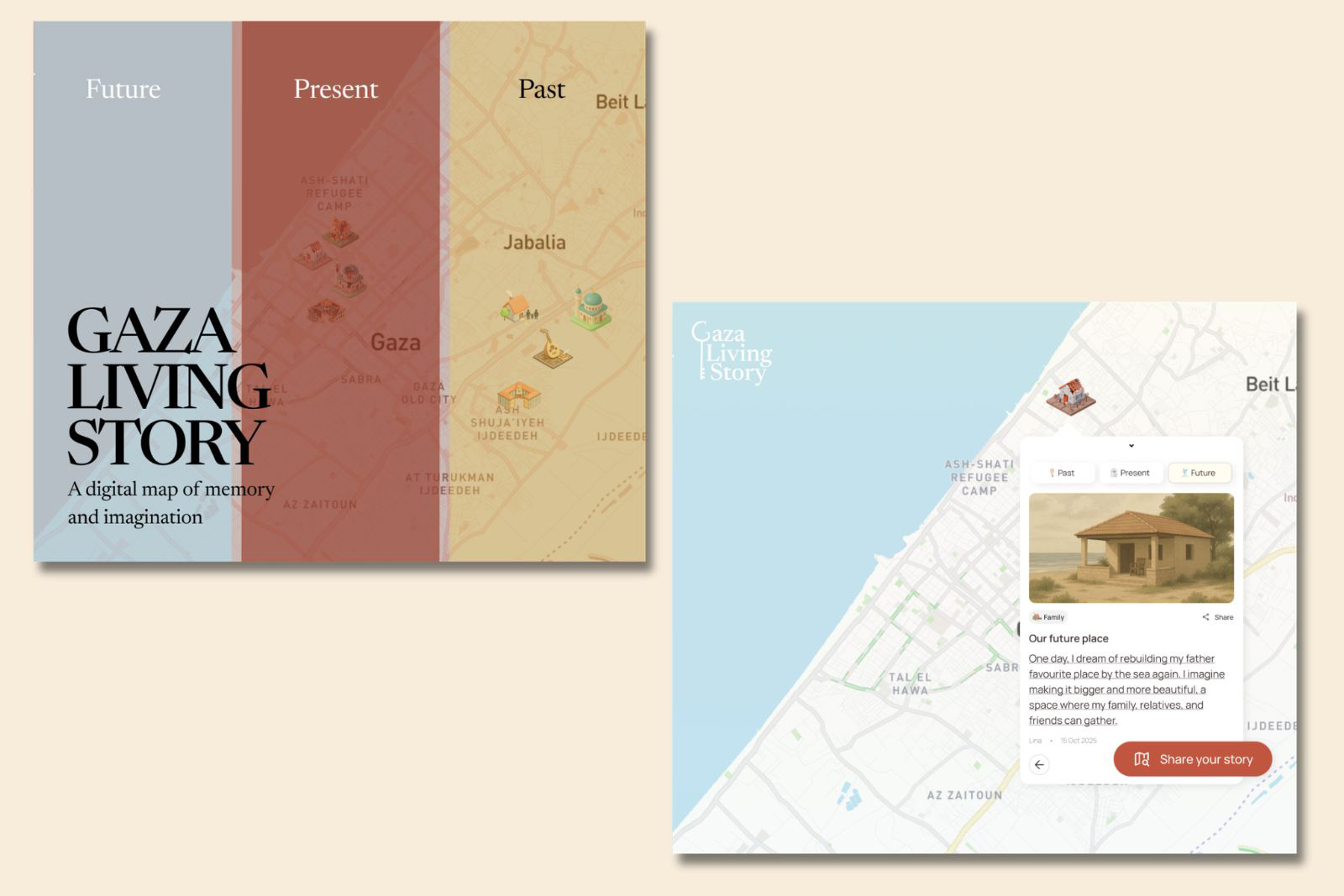
The initiative is an online repository of memories based on an interactive map of Gaza, run by Yalla Cooperative, a digital agency that connects Palestinian tech workers with international clients.
Launched in October 2025 with the British international charity Muslim Aid, the website allows people from Gaza to write posts and upload photographs tagged to specific locations. The contributions are deeply touching, reflecting on the past, present and, crucially, the future of Palestine.
Related content
Users are not asked to share their names. In order to protect their safety, the website does not collect contact information, such as email addresses. All entries are verified by the Yalla Cooperative team, then translated into English.
Many of the website’s users have tagged homes, schools, mosques and favourite places now reduced to rubble. Some remember better times, reminiscing about happy moments of everyday life: meeting a friend at a cafe or watching the World Cup in an Italian restaurant. Others share their desire to see their demolished homes, one day, rebuilt and normal life returned to Gaza’s streets.
“There are a lot of very powerful projects that seek to amplify Palestinian people’s voices in the present or document their suffering and memory, but Gaza Living Story goes beyond that to allow the people of Gaza to articulate what they want Gaza to be,” says Ayesh.
Ayesh, 31, left Gaza in 2023 after years of living through repeated Israeli bombardments and prolonged food shortages. As a young person, she experienced severe food scarcity in 2008 and 2009 and narrowly survived Israeli attacks in 2009, 2012, 2014 and 2021. Since the October 2023 attacks, Israeli strikes on the territory have killed more than 72,000 Palestinians, with thousands more missing.
“I have not been in Gaza for three years,” she says. “I still see all the places turning into memories around me. I never imagined that all the streets, all the cafes, all the different schools that I attended, the universities, the neighbourhoods would only exist in the past tense. I thought I would be able to go back to all these places, including my home.”
Now, Ayesh lives in Barcelona, Spain, where she was able to settle thanks to the country’s digital nomad visa scheme. She is now the director of operations at Yalla Cooperative.
The idea for the Gaza Living Story project came from discussions with Yalla Cooperative team members still living in Gaza.
“They told us that their stories are being taken away from them while they are bombed and starved,” Ayesh says. “We felt we needed a space where our voices can be heard without being changed or reframed.”
A year ago, Donald Trump announced his plan for a US takeover of Gaza that would change the devastated landscape into a “riviera of the Middle East.” On 12 March, UK foreign secretary Yvette Cooper hosted “a peacebuilding conference” in London, which, according to the government, was set to include Israeli and Palestinian civil society leaders.
“These plans and conferences, like the one coming up in London, look at turning Gaza into investment decks,” says Ayesh. “They look at how to rebuild Gaza in a way that investors want. It is the worst version of capitalism.”
Related content
The website now hosts around 300 entries. On 4 February, a user going by the name of Nada posted photographs of the ruins of her family home in Bani Suheila, just outside the city of Khan Younis.
“We celebrated birthdays there, ate together and believed we were building something permanent,” Nada wrote. “Now 30 years of work returned to us in three large flour bags. We will rebuild our house. I am sure and certain.”
Other entries express less hope for the future. Zayyoun, a site user now seeking asylum in Norway, wrote: “There are no words left for anger, hatred, or grief. No tears. No sanity. What humanity does Europe pretend to represent?… Who gave it the right to do this to us?… I’m sorry if this sounds too raw, too much, but this is the real face of life now. The only hope I have left is in something miraculous. Something that lets us breathe again.”
As Ayesh explains, the widespread narrative of Palestine has long been created by Israel, rather than Palestinians themselves. The Gaza Living Story project aims to create a space where Gazans can own the conversation.
“In the past I think it was difficult for Palestinians to share their stories,” she says. “If you are able to hear from someone directly, either virtually or in person, it makes a big difference.”