

Mandelson is still Starmer’s problem — and Labour MPs know it

The prime minister and his team can’t escape the fact they chose a US ambassador whose links to Jeffrey Epstein were far from secret

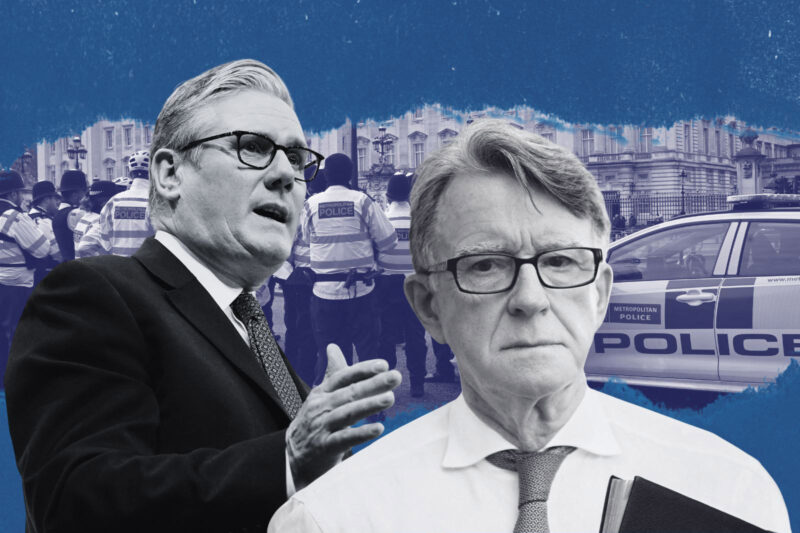
Peter Mandelson, the man who survived more political deaths than a cat with nine lives, appears to have run out of road at last. And what a road it was: paved with ambition, controversy and, it turns out, rather more contact with Jeffrey Epstein than anyone in Downing Street apparently knew.
But political scandals are, as one MP once put it to me, “more like wildfires than anything else”. The initial blaze draws the cameras, but it’s the direction the wind blows next that determines where the real damage is done. And right now, among a growing number of Labour MPs, it is clear they believe the wind is blowing straight towards Keir Starmer.
Yes, the prime minister’s spokesperson delivered what can only be described as a verbal execution of Mandelson, saying the prime minister was appalled by what he had seen and that Mandelson had “let his country down” and should be stripped of his peerage (Mandelson ultimately chose to quit the House of Lords before he could be pushed). And yes, the government is falling over itself to stress how “enthusiastically” it is cooperating with police inquiries into potential misconduct in public office and breaches of the Official Secrets Act and data protection laws that are alleged to have taken place when Mandelson forwarded confidential government emails to Epstein in 2010.
Related content

All of that is meant to draw a firm line under the affair. But it hasn’t answered one of the most uncomfortable questions for the government: why was Mandelson appointed ambassador to Washington in the first place?
Mandelson’s links to Epstein were not exactly a state secret. Questions had been asked, rumours had circulated, eyebrows had been raised prior to him getting the job. But even setting that aside, his political career has always been steeped in controversy. The self-styled Prince of Darkness resigned twice from Tony Blair’s cabinet — once over an undeclared loan and once over the improper use of his office in a passport application.
Now he is being viewed as a walking emblem of everything voters loathe about modern politics: entitlement, evasiveness and a disturbingly casual relationship with standards the rest of the country is expected to live by.
The opposition can smell blood. The Conservatives are using parliamentary tricks to try and prise open internal documents and force out a paper trail, demanding to know what No 10 knew and when it knew it. Their case is brutally simple: either Starmer knew about Mandelson’s baggage and waved it through, or he didn’t know because he didn’t look hard enough. Neither sits comfortably with a prime minister who sold himself as forensic and serious.
“This never needed to be a scandal,” one Labour MP said to me. “It becomes our problem because he was put back into a public role.” It was, they added, an “own-goal” and an “unnecessary risk” to reappoint him: “The prime minister and his team should have known better.”
For other Labour MPs, the Mandelson affair has reignited long-simmering anger at Morgan McSweeney, Starmer’s powerful chief of staff and someone who was viewed as a long-time Mandelson protege. MPs who already feel sidelined see this as further evidence that a small, insular group at the top is making big decisions and getting them badly wrong. Some are privately hoping that, if the document trail is dragged into the open by opposition pressure, it will become clear who pushed hardest for Mandelson’s appointment.
Related content

With potentially more emails and more revelations to come, the danger for Starmer is that this scandal plugs directly into a wider unease about his leadership: poor polling, a looming by-election, local elections that could go badly in May and a growing sense among some of his own MPs that his political judgement isn’t always great. In that context, Mandelson is no longer an isolated error. It starts to look like part of a pattern.
That is partly why Starmer’s response has been so ferocious. The total refusal to offer Mandelson even a flicker of political cover is not only because No 10 clearly feels there is no defence but also because it needs to draw a thick red line between the government and its former ambassador.
“The prime minister needs voters to believe he’s been betrayed — that this is all Mandelson and he couldn’t have known,” one Labour MP put to me.
But politics is rarely that neat. You do not escape scrutiny simply by denouncing someone loudly. While Mandelson may be off the pitch, the game he leaves behind now belongs to Starmer, who will have to deal with the consequences.
Shehab Khan is an award-winning presenter and political correspondent for ITV News.